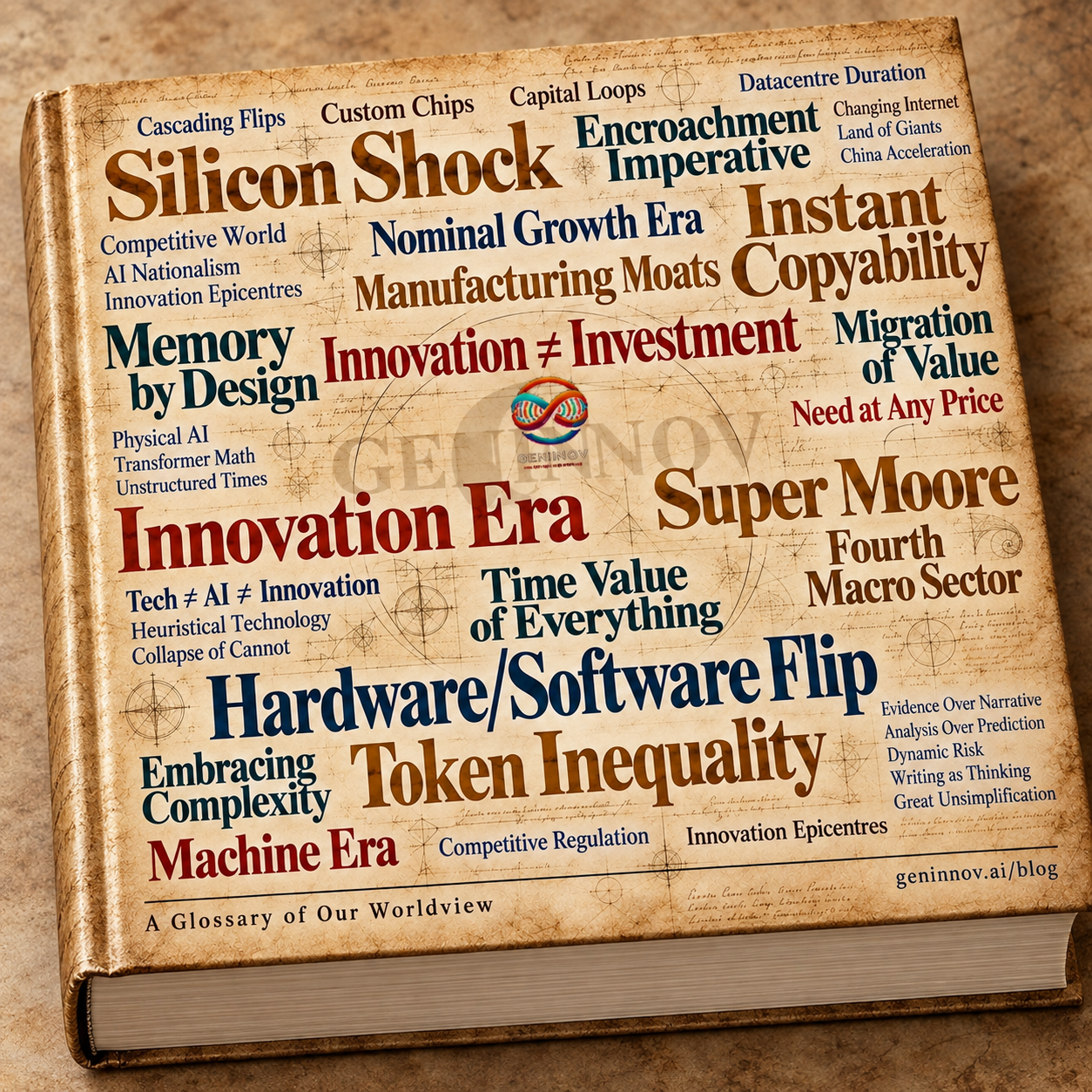
Certain ideas define us. Some earned names of our own along the way. Others have run through nearly 240 pieces without ever being formally christened. Put together, they amount to a worldview.
That worldview has been assembled one essay at a time since 2023. Many readers have walked in mid-conversation. Mention the Hardware/Software Flip, Super Moore, Instant Copyability, Silicon Shock, or Token Inequality, and a reader of three years nods along while a reader of three weeks walks away frustrated. Long-time readers may find something new here too. The ideas now lean on each other so heavily that seeing them side by side reveals connections no single essay could.
This glossary is our attempt at that. It follows the order in which we think, with no alphabet and no predictions. We start with the changing nature of innovation and machine intelligence. We move through competition, the unwinding of the old software order, the return of the physical stack, and the redrawing of geography and power. We end with the questions we keep brooding over and how we try to invest in all of it. Each idea stands on its own. Each also changes the meaning of several others. That is the bigger point.
Among the questions it tries to answer:
- Why will the hardware buildout last for years, as computing swings back from personal devices to collective machines?
- Why may innovation be the last durable growth theme left in the world economy?
- Why do lessons from railways, telecoms, and 1999 mislead more often than they help?
- What happens to industries, markets, and nations when profits swing from software to hardware?
- Why is capex now the price of admission in technology, and what do companies lose by hoarding cash?
- Why is a brilliant idea now a weak moat, and a mundane manufacturing process a formidable one?
- Why can memory, packaging, optics, cooling, and power matter as much as the processors everyone discusses?
- Why might access to tokens and compute become the new inequality between companies and countries?
- Why will AI spill out of technology into economics, geopolitics, and domestic politics?
- How does risk change when technology turns capital-hungry, growth turns nominal, and shares become currency?
- Why must an announcement, a roadmap, or even real technical progress never be mistaken for an investment case?
- With the elevator pitch dead and visibility collapsing, how do we stay ambitious about technology while assuming most companies, architectures, and theses will fail?
What follows is our current answer.
The Age We Think We Have Entered
Innovation Era: The World of a Billion Einsteins
We live in the age of a billion Einsteins. General models now hold dozens of fields at once and work alongside scientists in biology, chemistry, mathematics, materials, and chip design. In recent months, they have designed proteins that bind in the lab, overturned an 80-year-old Erdős conjecture, and lifted a long-standing bound on the Riemann hypothesis. Machines are only half the story. Capital, talent, and corporate and government attention are turning toward invention with an intensity unseen in decades. New intelligence and renewed human focus feed each other.
Much of the gain comes from crossing boundaries. We divided knowledge into fields because one skull could hold only so much, and every handover between specialists loses time and part of the question. Models carry no such limit, and nature never agreed to our departmental charts. Some of the biggest discoveries may sit in the gaps between disciplines whose experts rarely talk. The loop is also closing: models now help design the algorithms, data, and chips that train their successors.
AI is the engine; innovation is the theme. Much of this glossary follows from it. Chatbots, humanoids, agents, and any given chip architecture are passing manifestations. Many will fail. That is why we run an innovation fund, with themes we expect to keep changing.
See: Overcoming the Limitations of a Skull and Beyond AI: The Rise of the Innovation Era
Fourth Macro Sector
Agriculture, industry, services, and now a fourth macro sector: machines that produce cognition. In this Machine Era, machines analyze, design, code, diagnose, and discover. They are starting to act in the physical world. When output no longer needs matching human thought, the lines between capital, labor, and services blur. Investors should spot the sector before statisticians name it. Like its predecessors, it needs its own factories, materials, and energy.
See: The Advent of the Fourth Macro Sector: The Machine Era
GenAI Rupture
Transformer-led GenAI is a break from the AI that came before. The internet connected people to existing information. Generative systems create, infer, and recombine it. Calling rules engines, narrow prediction models, and today's systems all "AI" hides the gap. Expertise built on the old architectures buys little on the new one. Incumbency can even hurt when existing products and economics limit how far a company will rebuild. Nor is the new architecture settled. Transformers and their successors will keep evolving fast, often in directions nobody planned.
See: Why AI Is Bigger than the Internet and The Transformer Tsunami: How New Tech Is Swallowing the Old
Super Moore Era
Moore's Law described one exponential. Today dozens run at once: transistor density, parallelism, memory bandwidth, networking, model scale, algorithms, quantization, synthetic data, software optimization, and increasingly machines doing research themselves. Their interaction is the Super Moore Era. When one layer stalls, another carries the load. When several advance together, gains compound. Progress arrives from many directions at once. Few people see the next turn coming, including those building it. Ideas now spread as fast as they improve. Instant Copyability, later in this glossary, is the same acceleration seen from the competitor's side.
Cheaper intelligence also means more of it. When cost falls and usefulness rises, consumption explodes. The largest effect is often demand that did not exist before. An efficiency breakthrough rarely ends hardware demand.
For investors, this undoes a deep habit. Multi-year forecasts quietly assume a near-constant world, with today's products, costs, and competitors extended in straight lines. In an exponential era, those assumptions decay within quarters. A company's position today says less about its position in three years than at any time in memory. Keeping the option to change our minds is a working requirement. We exercise it often.
See: The Super Moore Era
AI Is Our Economics, AI Is Our Politics
AI reaches every argument societies already have: jobs, wages, inequality, education, national power, intellectual property, defense, and who keeps the gains. So the debate will never end. It will preoccupy voters, governments, and boardrooms for decades. Each new capability will reopen questions that seemed closed.
Nobody will hold a settled view for long, ourselves included. As the fourth macro sector keeps shifting, people will swing between fascination and fear, sometimes within the same week and about the same model. Every society will carry both instincts at once: accelerate, because falling behind is costly, and restrain, because the disruption is real.
Regulation will arrive in waves. Each will answer the last crisis, but none will settle the matter. For investors, these swings are part of the economics of AI. They shape where chips sell, where data centers get built, and where machines learn fastest.
See: AI Is Going To Be Our Economics. AI Is Going To Be Our Politics.
Token Inequality
The internet made information nearly free for everyone. Machine intelligence is spreading far less evenly. The gap may become the most insidious inequality of this era. The quality and speed of thinking a user can buy now depend on access to compute and the best models. A student on a free model, a company spending millions on inference, and a frontier lab with its own clusters are using different products.
Those with more tokens innovate faster. They compound their lead. Those behind, whether for lack of hardware, money, or access to frontier models, grow more vulnerable each year to those racing ahead. The divide runs between people, companies, and countries. It can widen even as average models improve, because the frontier moves faster still.
See: Big Theme: Token Inequality
What Kind of Intelligence Is Emerging?
Transformer Math
Beneath the products sits a mathematical architecture that keeps escaping the domain that made it famous. Attention finds relationships in language, code, proteins, images, and molecules alike. It works as a general mechanism for discovering structure in complicated data. That is why we hesitate to judge its limits by this month's chatbot rankings. Important mathematical instruments tend to find uses nobody anticipated. The app is temporary. The mathematics endures.
See: Attention: A Mathematical Revolution with Far-Reaching Implications
Heuristical Technology
Classical engineering puts causality over capability: understand the mechanism, design the system, predict the output. Generative AI often reverses the order. Capability appears before anyone can fully explain why or how far it will go. We call it a heuristical technology.
One result is a graveyard of confident claims about what machines cannot do. They cannot understand context, reason, write useful code, create anything new, or plan ahead. Most of these boundaries lasted months. A portfolio built on a machine's permanent inability to do something rests on a more fragile assumption than it appears. We treat "cannot" as a proposition to test. There will be limits. We are reluctant to appoint ourselves their discoverers in advance.
Such a technology rewards observation. Investors who wait for a full explanation before accepting the evidence watch the phenomenon advance without them. Progress can surprise, and promising demonstrations can also stall. Low visibility is a condition to manage. It excuses neither blind enthusiasm nor reflexive rejection.
See: The Collapse of 'Cannot': When Models Break Intuitions and The World of Zero Visibility
Unstructured Times
The computer era was built on structure. Humans created schemas, fields, menus, and databases so machines could process an orderly copy of reality. Generative models invert that relationship. People supply prose, images, or a vaguely stated goal. The machine builds enough structure internally to act. The move from analog to digital was about capturing information. The move from structured to unstructured is about understanding it, whatever form it arrives in. Workflows, software categories, and even job descriptions were shaped around the limits of older machines. Some of those boundaries now look optional. Much of what we mistook for the natural shape of knowledge was scaffolding required by older computers.
See: From Structure to Fluidity: The Math of Meaning and Time to Discuss the Demise of Our Beloved Structures
Physical AI
Digital intelligence eventually wants to escape the screen. Chatbots talked. Agents act on our devices. The next stage carries cognition into all things inanimate: robots, vehicles, warehouses, power grids. Humanoids matter because our world was built for the human body. They are only one form of embodied intelligence. Reality is unforgiving. A wrong paragraph can be regenerated. A robot that misjudges a staircase cannot. Sensors, motors, reducers, batteries, controls, and manufacturing yield stay crucial, and abundant cognition raises the value of the hardware that turns it into reliable action. The boom will be broad and the moats rare. The investment question is where they form.
See: Beyond AI: The Rise of the Innovation Era and Robotics Investments: More Than a Brain
Competition When Ideas Travel Instantly
Instant Copyability
Ideation has become a commodity. A good idea in AI now spreads, gets copied, and gets improved faster than its originator can turn it into lasting profit. In the last few weeks, persistent agents of the kind Instinct showcased have appeared from several model makers and vendors in quick succession. The pattern has repeated across the past four years. Text-to-image, text-to-video, deep research, coding agents, and personal agents each began as one company's breakthrough. Each became a crowded category within months. The pioneers shaped their markets. Few kept the profits their ideas once would have earned.
The mechanics explain why. A paper appears, a model explains it, repositories reproduce it, engineers modify it, and competitors ship it. What once took years of organizational learning now takes weeks. Open source speeds the process further. Patents struggle when the technology moves faster than the legal process around it. Models also generate ideas in volume. The supply of good ones keeps rising while their shelf life keeps falling.
Money can still be made from innovation. Ideas alone earn far less than they used to. For decades, the prize went to whoever got there first, because generating ideas was the scarce act. Now the rewards go to what stays hard once everyone understands the idea, and the Migration of Value entry below gives our usual answers.
See: A Million Model Milestone: When Quantity Becomes the New Quality
Competitive World
AI has arrived in the most competitive corporate system ever built. Every participant faces the same choice set. Customers, suppliers, and rivals have access to many of the same models, engineers, and ideas. Every board knows that someone else will pick up a project it declines, often the competitor it fears most. "If I don't do it, the person I hate the most will" explains more AI spending than any ROI model. Governments follow the same logic. A country will occasionally feel the urge to slow or control the technology. The fear of a rival pressing ahead usually wins. Unilateral restraint mostly hands the other side the ground.
The stable territories of the last era are dissolving as a result. Search companies enter the cloud. Cloud companies make chips. Model companies build infrastructure. Chipmakers sell systems. Device makers build models. Neatly separated industry leaders have given way to continuous collision among giants.
See: Clash of the Giants: When Tech Titans Collide
Encroachment Imperative
The biggest efficiency gains now come from combining layers. A chip designed together with its memory, packaging, networking, and cooling outperforms one optimized alone. Separate specialists, each perfecting one layer and handing it to the next, lose ground to whoever can engineer the whole system. The same boundary-crossing that drives discovery in science now drives efficiency in industry.
This leaves the giants little choice. Logic foundries have moved into advanced packaging. Memory makers now build logic into their stacks. Chip designers sell complete systems. Hyperscalers design their own chips. Manufacturers move into design. Each step takes territory that once belonged to specialists. Rivalry plays a part, and so does strategic desire, but the deeper force is engineering: once the gains sit at the joins between domains, whoever controls more of the joins wins.
Specialists used to be protected by difficulty. A hard niche cost an incumbent too much effort to enter. Today, a niche that becomes important enough to the combined system draws in the companies with the most talent, capital, and reason to absorb it. Suppliers become competitors, customers bring components in-house, and partners move along the stack. Technical difficulty and defensibility have come apart. Our first question about any specialist is whether its layer is likely to be pulled into someone else's system.
See: Goliath's World and the Encroachment Imperative
Need at Any Price
Some technologies cross from desirable to strategically necessary. Once a rival's adoption threatens your survival, the purchase decision changes. AI and parts of its infrastructure, from compute to frontier memory to power, are entering this regime. Buyers complain about the price. Then they compare it with the cost of operating without enough. Price elasticity behaves strangely when the alternative is strategic irrelevance. Plenty of AI spending will earn poor returns. Spending can still stay enormous while direct ROI is uncertain because competition rewrites the calculation. The absence of a clean return spreadsheet does not mean rational demand is absent.
See: Revisiting the Statistical Parrot and The Strategic Calculus of AI: Returns Beyond ROI
Migration of Value
When something becomes abundant, value moves to what remains scarce. If models make drug-design ideas cheap, biological validation, patient data, clinical trials, and manufacturing gain value. If software becomes easy to write, distribution and trusted workflows matter more. If chip architectures become easy to understand, making advanced silicon at commercial yields becomes the prize. We call this the Migration of Cognitive Value. It is the bridge between our AI and hardware theses. Abundant machine intelligence does not make knowledge work worthless. Its value moves downstream or sideways, into the parts of the chain intelligence alone cannot complete. The blank page loses scarcity. Reality keeps it.
See: Drug Discovery: The Migration of Cognitive Value
Land of Giants
The mythology of technology starts in garages. Frontier innovation increasingly starts with a power contract. Data centers, fabs, advanced drug manufacturing, frontier-model training, and robot factories need capital on a scale the software era rarely saw. Startups survive, though they compete in narrower places and often depend on infrastructure owned by giants. Capital itself becomes a capability. A company that can finance ten years of infrastructure, recruit thousands of specialists, and absorb failed generations owns a moat that appears nowhere in its source code. The venture playbook maps poorly onto this. A frontier program resembles a fab. Its funding cannot pause after each floor while everyone decides whether to pay for the next.
See: Innovation in the GenAI Era: A Shift Away from Garages
Innovation ≠ Investment
The easiest mistake in our field is treating evidence of innovation as evidence of a good investment. A long chain separates the two. Does it work outside the demo? Can it be manufactured? Will customers adopt it? Will rival technologies improve faster? Will the company keep the economics? Will capital needs swallow the returns? And if everything works, what price did the investor pay?
A newer risk now sits at the front of that chain. Innovation has become the main growth story in markets. Companies well outside technology have learned that announcing new products wins valuations. Most of what gets announced is a plan. Most plans need years and large sums before anyone knows whether they worked. Physics does not yield to applause at a conference. Whether an innovation pays also depends on innovations in other fields. Some are prerequisites. Some are substitutes that can make the whole effort pointless. Some are customers whose own success decides whether anything gets paid for.
Many technically successful innovations never become meaningful businesses. Some transform their industries and still earn poor returns, with the gains flowing to customers. We want exposure to innovation without credulity about innovators. Attempting matters, and so does serendipity. Execution, economics, and valuation matter just as much.
See: To the Attempter, There Might be Spoils, The Role of Serendipity in Innovation and The Real Loops of Innovation
Calendar Cost
Time has acquired an explicit price. In slow industries, delay merely postpones benefits. In fast ones, six months can rewrite the comparison. The chip generation turns, power becomes unavailable, qualification cycles move on, a rival accumulates data, a better model voids the old workflow. A project that looked expensive can turn cheap next to waiting. We call this the Time Value of Everything. Acting early can strand capital in obsolete architecture. Delay carries its own bill. Companies and investors must weigh two errors: arriving too soon and arriving too late. Sequencing, optionality, and the speed of learning become strategy.
The Old Software Order Unwinds
Two Deaths of SaaS
For two decades, adding "as a service" to a software business earned it a premium. Generative AI attacks that model twice. The first death comes from Instant Copyability. Code is cheap to write. Open-source alternatives multiply. Customers build what they once rented. AI becomes a capability inside every product. Users stop paying for dozens of separate subscriptions. The second death comes from cost. Classic software was magical because the next user cost almost nothing. Generative software burns inference exactly when it does useful work, while agents shrink the human seats that pricing was built on. Vendors are responding with consumption pricing, outcome pricing, and tolls on agent access. This has made software one of technology's more inflationary corners. Software remains important, but its economics and pricing moats have changed.
See: Software's Tollbooths, The Second Death of SaaS and From XaaS Boom to GenAI Bust? The Changing Fortunes of "Everything-as-a-Service"
Hardware/Software Flip
For forty years, software was scarce, and hardware was its commoditized servant. Software is now the easy part, copied in seconds. Frontier hardware meanwhile grows more specialized, capital-hungry, and physically difficult. Computing is also swinging back from personal devices to giant collective machines, much as it ran in the mainframe era. Models wait on accelerators, memory, packaging, networking, cooling, and electricity. Bargaining power moves to the constraints code cannot wish away. This flip is the main reason our portfolio leans toward the physical stack described in the next section.
See: Tech Is Dead as We Know It and Hardware/Software Flip: When the Servant Is the Master
The Physical Stack Returns
Cascading Flips
The Hardware/Software Flip was the first reversal. Others follow inside hardware. Value is moving from chip design, the "office" work of hardware, toward manufacturing, its "plant" work. Memory gains on logic. Process engineers regain status over purely digital functions. Each relieved constraint hands the scarcity to another layer. The hierarchy keeps inverting. Investors who carry one fixed picture of where value sits will find the next decade uncomfortable.
See: Chip Design: Hardware's Software and A Personal Odyssey Through Samsung and TSMC
Manufacturing Moats
Instant Copyability has an opposite: tacit knowledge. A semiconductor process can be described in exhaustive detail and still prove impossible to reproduce at competitive yields. The knowledge lives in thousands of accumulated adjustments, supplier relationships, engineering habits, and past failures. Money buys equipment. It cannot compress the years of learning that come from running that equipment at scale. The same holds in biomanufacturing, batteries, and robotics. In a world intoxicated by ideas, execution deserves the premium.
See: Climbing the Semiconductor Everest: China's Unconventional Ascent
Custom Chips
At sufficient scale, inefficiency becomes expensive. As a result, hyperscalers, model companies, and device makers now design silicon around their own workloads. The chip shifts from a product you buy to part of the system you design. We call this the second AI race. The model race gets the headlines, while the race to control the silicon underneath can redistribute far more industry profit. It also creates less obvious winners: design-service firms, IP providers, packaging specialists, and foundries that help customers build a chip of their own.
See: A Chip of One's Own and 2026's Real Chip War
Memory by Design
Memory was the archetypal commodity, with interchangeable bits, violent price cycles, and little differentiation. AI makes bandwidth, proximity, packaging, power, and qualification central to system performance. Memory is now designed together with the processor and the workload. HBM is the clearest case. The idea reaches into caches, storage hierarchies, and the growing problem of moving data. Cycles will continue. Today's scarcity will not last forever. The question that decides how to value memory is whether its price floor and technological role have changed for good.
See: 2027 Theme: Memory by Design and Is DRAM at a Permanently Higher Plateau?
Silicon Shock
Silicon Shock
Silicon Shock is our name for what happens when explosive demand for computation meets physical supply chains that cannot grow at software speed. It starts with chips and spreads to memory, packaging, substrates, optics, transformers, switchgear, electricity, cooling, construction labor, and land. For decades, technology made almost everything it touched cheaper. This buildout makes intelligence cheaper while making the physical inputs that produce it more expensive. This turns technology into an inflationary force.
The effects reach well beyond tech income statements. Data centers compete with households and factories for power, and electricity bills rise. Memory shortages raise the cost of phones and PCs. The buildout absorbs capital, labor, and materials that other industries need. The effects flow into inflation, interest rates, trade, and industrial policy. This will last more than a quarter or two. We are afraid it may last more than a year or two. Fabs, grids, and power plants take years to build. Demand compounds every time the new intelligence causes new use cases like the agentic chatbots of the last few weeks. We treat Silicon Shock as a macro theme for the rest of this decade. It will touch nearly every part of economic life.
See: Silicon Shock: The Big '26 Theme, Silicon Shock: The Macro of Tech Inflation and 100 Signs of Silicon Shock
Datacenter Duration
The bubble debate assumes the world needs a fixed stock of compute, after which construction stops. Frontier data centers are evolving factories. Each generation brings new power density, cooling, networking, and memory. Older halls may not compete with newer ones. Cheaper inference keeps creating new workloads, so efficiency expands demand faster than it trims usage per task. Many announced projects will prove unnecessary or unprofitable. Applying the one-off overbuild logic of railways or fiber, without studying how the machine itself is changing, produces a dangerously incomplete analogy.
See: The Cassandra Cascade: On the Industrialization of Fear
Stack Bottlenecks
The AI computer is a system. Improve the accelerator, and memory becomes the constraint. Fix memory and networking binds, then power, then heat, then grid connections and transformers. That is why we spend so much time on parts the AI story treats as peripheral: optics, copper, packaging, racks, voltage conversion, and thermal systems. Competing solutions often coexist. Copper keeps improving while optics advances. Pluggables survive as co-packaged designs arrive. The best economics usually sit at the moving bottleneck, away from the component getting the loudest applause.
See: Optical Rivalries: Where One Tech Must Lose for the Other to Win and Chip Matters Coz Chips Matter
Buy the Ship First
To trade in spices, a merchant first had to build a ship. Every industry in every era worked that way, except technology over the past thirty years. Software convinced a generation of investors that growth required building nothing physical, and a large capex plan came to read as a confession. That era is over, however much investors mourn it. For more and more technology companies, making money now means spending first. TSMC spends about $40 billion a year so that nobody else can, and the moat is often the spending itself. Capex carries a real risk of failure, and it changes the character of the sector. Capital-heavy technology turns cyclical. It is driven by its own supply cycles and, more violently, by rates, credit, and global macro. Innovation investors who would rather ignore macro are now more exposed to it than ever. Companies that hoard cash and refuse to build may face the larger risk.
See: Old Habits Die Hard
Capital Loops
Drawn on a page, AI financing can look circular. Hyperscalers commit to suppliers, suppliers finance customers, infrastructure owners borrow against long contracts, and equity valuations pay for capacity. Compute commitments have become a currency. Adding up reported capex misses how the system funds itself. Some loops build real capacity. Others magnify risk. Long contracts improve visibility and can hide oversupply. Vendor financing speeds adoption and shifts credit exposure. Each loop has its own incentives and exposures. Each needs untangling on its own terms.
See: Untangling AI's Loop Diagrams
Shares as Currency
To a secondary-market investor, a high valuation looks like a risk. To a company planning a decade of investment, it is cheap capital. Innovation depends far more on the cost of risk capital than on central bank rates. It also depends on the willingness to spend shares as currency on fabs, acquisitions, and talent. That willingness is a large part of America's edge, while bargain-focused markets elsewhere starve their own innovators. Equity wealth now also supports consumption, investment, and tax revenues. Hence, a deep market fall would do more damage than lower bond yields could repair. The worst bull markets are the wasted ones.
See: The Audacious American Edge: When Shares Become Currency and Of a World That Cannot Afford the Wealth Destruction Aftermath
Nominal Growth Era
The 1999 bust happened in a deflationary world of fiscal surpluses, young globalization, and technology that made everything cheaper. Today runs the other way. Deficits, tariffs, taxes, and Silicon Shock push costs up, and pricing power has become the new macro. Two half-empty restaurants side by side both raise their prices. Revenues and profits can surge while volumes grow modestly. This is why 1999 is a poor template for today's market. Nominal growth is still not free growth. Wages, power bills, financing costs, and working capital rise too. Inflation lifts earnings and discount rates together. Capital-heavy winners depend on financing staying open. Inventory mistakes cost more. Investors must separate real operating gains from growth produced by a shrinking unit of account.
See: Notionality of the Nominal Flood and Macro That Matters: The Lessons From Micron
Business Is Business
Technology stories often become morality tales when ordinary commerce explains them. Sellers of scarce products raise prices. Buyers lock in supply, then diversify once dependence turns dangerous. Competitors absorb profitable inputs. Governments step in when the stakes grow. The principle sounds too obvious to need a name, yet it stops us assuming that any company will protect another layer's margins or leave scarcity rents on the table. It holds across borders too. Incentives, competition, and scarcity explain behavior better than nationality.
See: Business of Business Is Business
Geography and Power Are Being Rewritten
Innovation Epicenters
Innovation clusters. Tacit knowledge, specialist suppliers, universities, capital, customers, and experienced workers reinforce one another, and proximity becomes an advantage. Detroit, Silicon Valley, Hsinchu, and Shenzhen grew from different industries through the same compounding. Today four epicenters account for most of our holdings: the US, China, Korea, and Taiwan. The last two remain the most underrated. Ask a dinner table to rank Japan, Korea, and Taiwan by income per head, and few will put Japan last, though it now trails Taiwan by almost 20% on purchasing power. Many investors' Asia tours still skip Seoul and Taipei. Our job is to find where hard-to-transfer knowledge is concentrating before capital markets price it.
See: The Geography of Innovation and Forget Tea Leaves…What Private Jets and Fried Chicken Tell Us About the Next Big Innovation Trade
Korea and Taiwan
Outsiders lump Korea and Taiwan together as hardware twins, but their societies differ. Taiwan turned its business leaders into national heroes. Its markets reward founders and engineers. Korea is fiercely patriotic yet has long been averse to investing at home, which left it with one of the world's cheapest equity markets and growth that rarely became shareholder wealth. Both markets share a habit that creates opportunity: local forecasts lag the evidence. Taiwanese server makers posted revenue growth above 100% while next-year estimates stayed in the mid-teens, and SK Hynix's earnings estimates had to be multiplied over ten folds in two years. The memory boom is now testing how long Korea's discount can last.
See: When a Society Finds Its Heroes: Taiwan's Tech Ascendancy and U.S. Analysts' Temerity vs. Korea/Taiwan's Timidity
Competitive Regulation
Global AI rules will not converge because governments compete too. One jurisdiction prizes safety, another speed, another its domestic champions, and companies choose where to train, test, build, and deploy. Regulatory arbitrage becomes learning arbitrage. A self-driving system allowed millions of extra real-world miles in one country gains an edge that caution elsewhere magnifies. Every government would like collective restraint. Every government fears its own restraint only helps a rival. Calls to regulate AI together are understandable and strategically incomplete.
See: Plain Speak on Controls and Musk's China Trip: An Example of Emerging Regulatory Arbitrage
AI Nationalism
Compute, models, chips, biotech, and energy are now instruments of national power. Countries chase sovereign compute, domestic fabs, model champions, and trusted supply chains. The world grows more connected in ideas and more fragmented in things. An algorithm crosses borders instantly while governments spend billions to keep its chips, power, and data at home. Duplicate fabs, subsidies, export controls, and parallel supply chains look wasteful to an economist. To a government that treats dependence as a security risk, they look rational. Much of that spending lands on the physical stack.
See: Innovation in a World of Distrust and Nexus and Other Vexatious AI Issues
China Acceleration
China now challenges the assumption that frontier innovation starts in the West, across AI models, EVs, batteries, robotics, biotech, and chips. AI shows it most clearly. Export controls denied Chinese labs the best hardware, so they hunted efficiency obsessively, and DeepSeek was the first loud signal. Since then, Chinese teams have adopted mixture-of-experts designs almost universally and keep finding new ways to route, sparsify, and compress. They release more open models than anyone, with papers and downloadable weights. Western developers increasingly build on them. Breakthroughs are likelier where more methods are tried, and China is now the busiest explorer of the model space. In biotech, policy, regulatory speed, manufacturing, and capital have combined into what we call an Accelerationist State. China is neither destined to dominate every technology nor condemned to imitation. Treating it as a factory for other people's ideas no longer works.
See: Nothing Is Given: Of China's Open-Source Tsunami, DeepSeek's Efficiency Leap: Could Lightning Strike Twice? and The Accelerationist State: China's Biopharma Industrialization
What We Keep Brooding Over
AI Is a Multitude
There is no single AI. Thousands of models, each trained, tuned, and prompted differently, now sit upstream of what we read. Call transcripts, filings, and news reach us after machines have parsed and distilled them. A company's earnings call is increasingly judged by how models read its tone. Machines are starting to define what counts as an event. We have barely begun to work out what that does to markets, persuasion, and truth.
See: GenAI's Ontic Take: When AI IS Not
When Words Fail
Innovation now moves faster than our ability to describe it. Fresh phrases from podcasts and panels pass for understanding. Investors chase terms they cannot define. Regulators draft rules without definitions. Capital is raised on slogans. A generational shift in technology is arriving without a stable vocabulary. We treat that gap as an investment risk to manage every day. We treat it as a reason to test products directly instead of trusting their labels.
See: Keeping Up with Tech When Words Begin to Fail
Observable Minds
Before it writes a word, a language model holds a probability spread across thousands of possible tokens, then commits to one, much like Schrödinger's cat. The difference is that every weight and activation can be inspected, paused, and replayed. No brain, protein, or galaxy allows that. Models built to answer questions may become laboratories for understanding complexity itself, with lessons that reach neuroscience, biology, and climate science.
See: The LLM's Schrödinger Issue
The Price of Prudence
When scale drives emergence, nobody can see the destination. The terrain forms underfoot only as one walks. Institutions and nations that waited for visibility in 2023 have found the door to frontier model-making shut behind them. Now they are as dependent as countries that cannot make advanced chips. Demanding strict ROI before acting looked prudent. In hindsight, it was a failure of imagination, and the same choice keeps returning in other fields.
See: Scale vs Skill: Time to Re-Learn Emergence
Fleeting Loyalties
Our own favorite model changes every few weeks. Each newcomer reasons, researches, or codes a little better, and last month's essential tool is forgotten. Users switch at no cost. A better product is always a release away. Which layer will ever earn lasting loyalty: the model, the interface, the data it holds about us, or the hardware underneath? We do not yet know. Much of the industry's valuation rests on the answer.
See: Infidelity Lessons and AI's Open Questions
How We Try to Invest in All This
Evidence Over Narrative
We have views. We try not to have loyalties to them. Innovation guarantees that elegant narratives will meet inconvenient evidence. Our job is to follow the evidence. We once expected AI inference to move quickly from giant data centers to devices. The argument was coherent. Reality disagreed, and we wrote the eulogy ourselves. Evidence comes in grades. A roadmap proves only a roadmap. A demonstration proves capability, a purchase order proves demand, and production qualification proves more still. Every important thesis also needs an exit door. Years of repetition give a view its own history, vocabulary, and emotional owners. New facts start getting bent to protect it. So we regularly ask what would prove the central thesis wrong. This is a harder question than what might make the stock fall next month. Optionality is the discipline that keeps conviction survivable.
See: Investing in the Maelstrom of Innovation: A Guide for the Cautious Yet Ambitious, Edge Computing: A Eulogy for a Future That Wasn't and Of Pejorations and Perjurations
History's Hallucinations
Almost every technology debate maps onto a precedent: railways, canals, telecoms, electrification, the dot-com bust. Enough episodes exist to support any conclusion an analyst wants to reach. We call this danger History's Hallucinations. The useful question is which causal mechanisms from 1999 still operate. Capital structures, technology, speed, customers, policy, and the cost of falling behind have all changed. History should generate questions. The more unprecedented today's mix becomes, the more dangerous it is to swap direct analysis for the comfort of resemblance.
See: History's Hallucinations and Cassandra 1: The History Seekers
Embracing Complexity
The elevator pitch suited an era when a business could be reduced to a few durable variables. Innovation investing has moved the other way. A model company depends on chips. Chips depend on memory, packaging, equipment, and power. Power depends on grids, permits, and capital. Customers finance suppliers, suppliers become competitors, geopolitics reshapes architectures. One breakthrough moves the bottleneck elsewhere. We call this the Great Unsimplification. The interactions among the pieces are now the thesis. Simplifying helps communication. It becomes dangerous when it deletes the mechanism that matters. The elevator pitch is dying because the building no longer has one floor.
See: The End of the Elevator Pitch: Why Innovation Investing Got So Hard
Analysis Over Prediction
Finance admires decimal places that innovation rarely deserves. When paths branch, rivals respond, and serendipity intervenes, a precise five-year forecast mostly disguises uncertainty. It is rational to call a market enormous without pretending to know whether it reaches $480 billion or $630 billion, and to own a company because several plausible futures favor it. Feedback loops and reflexivity make point forecasts fragile in markets, elections, and technology races alike. Analysis earns its keep in other ways. It maps mechanisms, dependencies, and alternative outcomes. It names the evidence that would falsify a thesis and spots when the world has moved. Waiting for certainty usually means buying after the repricing.
See: Imprecision Is the New Risk: Who Is Ready? and AI and Predictions: Coin Tosses, Elections and Financial Markets
Dynamic Risk
Risk changes when the structure of the world changes. Volatility can be lowest just before a technology makes a business model obsolete. A volatile innovator can carry less fundamental risk than a placid incumbent facing disruption. Correlations from an old regime fail exactly when investors lean on them. We track thesis risk, valuation, technological substitution, financing, concentration, liquidity, competitive attack, and the chance that our own framework is wrong. We built our own risk engine to do it. Risk management in innovation means knowing which uncertainty one is being paid to own.
See: Introducing GenInnov's Proprietary Risk Management Tool
Long Horizons
The more often you look at a portfolio, the more volatile it appears. Daily noise drowns the long-term signal. Even the Sharpe ratio can be flattered by measuring less often. Pension money thinks in decades while the people managing it are judged in months, and that mismatch pushes the industry toward trading. Brokers chase clients who turn over their portfolios repeatedly and have little time for patient long-only investors. We choose to be one anyway. Innovation compounds over years. A long-only portfolio gives compounding room to do its quiet work. In strong markets, the hardest discipline is to stop counting raindrops while the flood rises.
See: On Counting Raindrops While the Flood Rises and Standing Up for Long Only
Writing as Thinking
Writing is how we find out whether we understand what we think we understand. A thesis that sounds coherent over coffee can collapse once every causal link must sit on a page. Contradictions surface. Missing evidence becomes embarrassing. Unexpected connections appear. Writing is part of the analysis. The same logic drives our use of AI tools in our own workflows. Using the technology is another form of evidence about what works and how fast behavior changes. A worldview is a working document. It is rewritten as the world refuses to stand still.
See: It's Not You, It's Us and Innovating the Innovator: Our AI Journey
The Framework Behind the Glossary
There is a temptation, having assembled these terms, to turn them into a grand theory. We should resist it. If one idea links this glossary, it is almost the opposite: innovation does not owe us a neat path.
Machine intelligence can make ideas abundant while making electricity scarce. Falling token prices can still increase total compute expenditure and make individual tasks expensive. Instant Copyability can destroy one moat while strengthening another. More powerful software can shift economic value toward physical hardware. Efficiency can stimulate demand. A technology invented in America can create its largest incremental opportunity in Korea, Taiwan, or China. A shortage can produce extraordinary profits and simultaneously finance the substitute that eventually destroys them. Regulation can slow innovation in one geography and accelerate it somewhere else. Every loop changes another loop.
That is why we keep returning to evidence. Evidence never delivers certainty. The alternatives deliver even less. Historical analogy is seductive. Elegant theory is comforting. Consensus forecasts are convenient. None has a privileged claim on a world whose underlying technologies are changing this quickly.
The technology will bring its own mix of good and harm. We have tried to name its vices honestly: the hubris, the speculative mania, the resentment of the excluded, the anger of the displaced, and governance that cannot keep pace. We have tried just as hard with its virtues: clarity in opaque worlds, agency for ordinary people, translation across a thousand walls, and gifts nobody earned. Bad news makes a spectacle while good news becomes a statistic. The vices will dominate the headlines as the virtues accumulate quietly in ordinary lives. Both lists will keep growing, often inside the same product. Investors who read only one will misjudge both.
Our worldview makes no claim that all innovation works, that every AI investment earns an adequate return, that every shortage lasts, or that technological progress moves in a straight line. We have written often enough about failed theses, failed technologies, excess capital, and our own errors to know otherwise.
We believe something unusually large is happening. Its effects increasingly extend across sectors once treated as separate. Understanding the interactions is more useful than attaching ourselves permanently to either optimism or pessimism. The cost of refusing to engage with the complexity may now be unusually high.
This glossary is where we stand today.