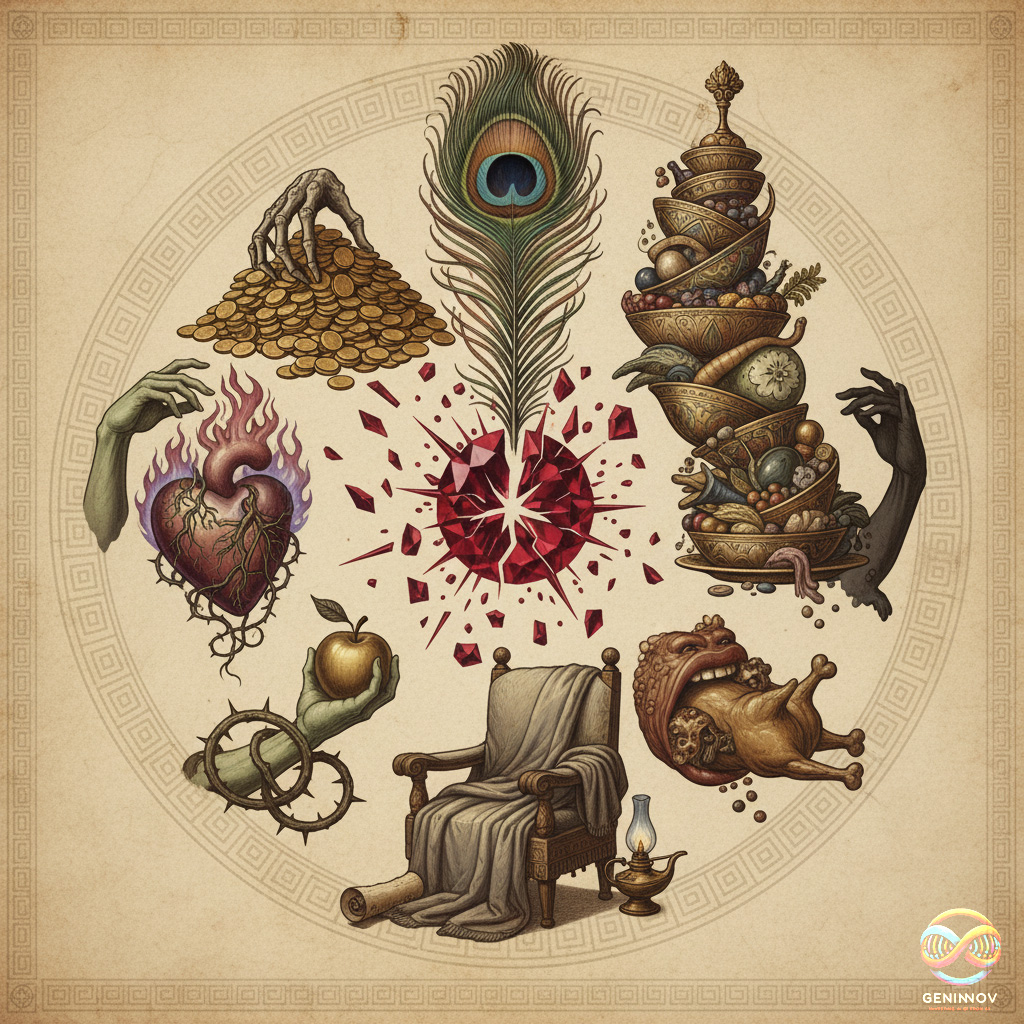
It’s that time of year again when the world slows just enough to look back. This festival season article is not only for those who’ve tolerated us through the year but also for the many new readers who’ve joined the GenInnov article community mid-stride. What follows is our reckoning with why we keep writing in a world that rarely reads slowly. But before our usual dose of summary-less verbiage, particularly those who may not reach the end, Merry Christmas, and Happy New Year 2026. May your curiosity outlive your cynicism.
The Ink and the Ego
The question arrives with the regularity of a margin call. Why do we do this? Why the endless spilling of ink when we could simply stare at the blinking green lights of the portfolio? The question carries reasonable weight. We are not sell-side analysts campaigning for votes. We are not influencers optimizing for dopamine hits and algorithmic favour. As proof of our spectacular failure in the attention economy, the cumulative likes we have gathered across all our dozens of articles this year on X could be comfortably exceeded by a teenager's first Instagram post to her thirty closest friends. Our tweet on the last article on X got seven views - for emphasis, seven views and not seven likes!
And it’s our fault. We careen from topic to topic like a pinball machine with broken flippers. Few follow the full trail; most graze a single bend. We refuse to summarize. We refuse to optimize. We have been told to start a Substack, to build a funnel, to get a grip. Even the house is divided; my partner often suggests we cap the pen, perhaps write once a month. A mercy killing for your inbox. To be honest, our writing has become popular enough to not only have many pieces commented on by people we respect and to have a buzzing website, but also to be indexed by all the major search and chat engine crawlers without any SEO optimization. It is good for our motivation that we are not the silent tree falling in the jungle, even though X seems to have found the most unique way of suppressing us.
The feedback loop is a cacophony and reliably contradictory, so we keep doing what we are doing without feeling the pressure to move in any specific way. Some beg for more volume. Some beg for brevity. Some want the bottom line up front, stripped of the prose. Here is the honest answer, offered without elegance: the way we write is a reflection of many things, but almost nothing aimed at any particular crowd. Our prose mirrors inner storms, unbound by crowds or conventions. Unlike the industry's polished pitches or hundred-page presentations full of charts brimming with confidence and designed for quick consumption, our articles are meandering, lazy journeys looking for an insight here and a wit there, with some time to extract something from the long memory to be shared and relived. Not the noblest path, perhaps, but the truest confession.
Articles of our Handbook
GenInnov stands on four tenets we repeat, almost ritualistically, in every monthly investor newsletter: Different Thinking, Different Processes, Different Portfolio, and Different Performance. This chant is not something we have ever mentioned in these blog pieces, but the write-ups are the foundations on which our institution is being built.
For the proudly tentative like us, the above paragraph may sound overly confident and too much of corporate-speak. The reality is that GenInnov is a young organism. We are a collection of refugees from other lives, other firms, other habits. We carry the invisible baggage of our pasts—the muscle memory of the sell-side, the short-termism of the trading desk, the cynicism of the old world. We are trying to build something fragile and fierce: a machine that thinks differently, powered by generative AI agents and risk models that don't exist in textbooks. But technology is cold. It does not have a culture. You cannot code a soul.
So we write.
Performance alone cannot carry culture. Returns are influenced by countless factors, many of which lie outside anticipation or control. A good year can conceal poor reasoning. A bad year can obscure sound judgment. Writing creates a parallel record that performance cannot: a visible trail of why decisions were made, not merely whether they worked.
Over time, this record becomes an audit of thinking. It reveals which trends we understood early, which ones we misread, and which successes were insight versus coincidence. It prevents retrospective storytelling. It holds us accountable to our own past reasoning, particularly in front of our own team members.
Writing also acts as institutional memory. Organisations forget faster than individuals. As teams grow and evolve, original intent is often diluted not by malice but by entropy. Writing freezes early convictions and early doubts alike. It preserves how GenInnov thought before outcomes were known.
Equally important, writing forces a shared language.
Words like risk, conviction, innovation, and long-term are widely used in finance, often with entirely different meanings to different people. Writing forces definitions to be argued, refined, and agreed upon. Over time, it creates a common grammar, not ideology, not rules, but a way of thinking together.
For those who join GenInnov later, our writing serves as a living handbook. Not a procedural manual, but a trail of thought. It shows how problems are framed, what kinds of reasoning are considered lazy, and what kinds are respected. It allows people to self-select and understand early on whether this way of working resonates with them.
Whatever we write is an addition to our handbook of what defines us. A repository of our own evolution on these hard topics.
The Discipline of the Process
Writing, for us, is joyful work. But it is not light work.
There are days when sitting down to write feels like resistance training for the mind. It requires deliberately staying away from the day's drama or the compulsive need to read the emails and messages that have dropped in. Writing is committing to something slower, heavier, and less immediately rewarding. Writing is how we strap ourselves in and descend into that different mental register. When you rely almost exclusively on information sources and processes that are materially different from everyone around you—scientific journals instead of broker notes, primary research instead of consensus summaries—discipline becomes paramount. Not discipline as virtue, but discipline as survival. The mind, left unguarded, drifts toward whatever is easiest. The ticker. The headline. The macro drama that everyone else is discussing.
Writing frequently is how we belt ourselves into a different realm.
Depth is costly. The financial world rewards speed. It wants you to live in the present. It rewards arriving at conclusions quickly, declaring victory, and moving on. When ideas remain private, shortcuts are tempting. One can stop early. One can leave edges unexplored. One can ignore counterarguments without consequence.
Writing removes that luxury.
Once something is written and released, it becomes permanent. It will be read months later, years later, often by people who were not even part of the original context. Knowing this changes behaviour. It forces us to examine not only what we think, but how we arrived there. It forces us to check and recheck sources, a critical step in our age of hyperboles, hallucinations, and fake news. To question whether an argument is robust or merely convenient. To ask what we might be missing.
We like providing links to our previous articles, not to brag about what we might have got right, but to ensure we never forget we ourselves will be the readers months and years later of any slop we allow to slip in today. When we commit to writing for thousands of pairs of eyes, we are stripping ourselves naked. A shoddy argument in the middle of a three-thousand-word essay will rot there, smelling of laziness, haunting us months later when we dare to look back. We are terrified of that middle-paragraph mediocrity.
Writing also exposes the fragility of certainty. It requires us to articulate assumptions clearly, to recognise where information is incomplete, and to acknowledge where we may be wrong. It demands engagement with counterarguments and counter-counterarguments, not as rhetorical exercises but as genuine tests of conviction.
In an era where false confidence can be generated cheaply, writing becomes an act of intellectual hygiene. It is less about being right and more about being honest.
We write frequently not to speak more, but to think longer.
Writing in the Era of Unknown
If writing is the anchor for our culture, it is also our compass in a storm.
We are staring down the barrel of a new era. The signals are mixed, the noise is deafening, and the old maps are useless. It is easy to drown in the daily deluge of podcasts and pundits, to be swayed by the confident baritone of a commentator who is just as lost as we are. The world is full of people who are paid to have an opinion, regardless of whether they have a clue. Writing forces us to appreciate that factors shaping technology, economics, and society are complex, opaque, and deeply interconnected. Outcomes are nonlinear. Narratives are fragile. Writing allows us to avoid being swept into extremes. This may not be true for others forced to provide a certainty, a definitive view, a crystal ball, but we thankfully do not have the same requirements in our seats.
Rather, the opposite: Writing helps us resist the temptation that we know it all.
Writing forces us to stop listening and start seeing. Writing forces us to think about the moral, ethical, social, and economic dimensions of what is unfolding. It helps us pause for the philosophical aspects of the current revolution, one that is likely to be discussed for centuries. We have discussed how we could be at the onset of the fourth macro era, or why this could be the biggest mathematical revolution of all time: Writing makes one introspect deeply before making statements that otherwise sound silly and hurtful for one’s credibility, even in front of a mirror!
When we write through research, when we encounter all manner of conflicting arguments, we try to reconcile what we believe with its opposite. There isn't always a resolution. But one becomes far more aware of the enormity of whatever is happening beyond the surveys, beyond the superficial statistics, beyond the latest model release or proclamation of doom or triumph.
Writing cultivates awareness of what we do not know, and perhaps cannot know—a theme that has run through nearly everything we have published this year. And perhaps that is the truest answer. We write because the act of writing is how we think. Not 'we know, so we write.' Rather, we write because we don't know. The page is where we discover what we actually believe. Writing is inhabiting uncertainty comfortably.
This year-end piece is dedicated to all the readers whom we have ignored with our indulgences. For the many new subscribers, who despite all the warnings of how we have not written anything for anyone above (which is certainly only partly true), want to have some holiday readings, what follows is a tour of some of what we wrote in 2025: not everything, not even most things, but a selection that might serve as entry points for those catching up, or reminders for those who were there.
But before that, once again, Merry Christmas. May the new year ahead bring wonder where there was only routine.
The Tour of 2025
The Writing We Are Proud Of
These are the pieces where we tried to find the signal in the noise, often stumbling upon a bit of poetry in the process.
On Counting Raindrops While the Flood Rises (July 6, 2025) — Read →
Perhaps the piece that best captures our worldview: the reminder to see the flood rising even as we count individual drops.
Tech is Dead as We Know It (November 28, 2025) — Read →
AI's Seven Deadly Sins (September 13, 2025) — Read →
Four Sayings and a Diurnal (October 15, 2025) — Read →
The indulgence—the one we perhaps enjoyed writing more than anything else this year.
The Trends We Saw Before the Crowd
Investment research lives or dies by timing. These are the calls we made before they became consensus.
DeepSeek — Before the World Noticed
We were likely the first in global finance to recognize DeepSeek's significance, naming it our top innovation in early January—weeks before markets noticed and months before it became a household name.
To the Attempter, There Might be Spoils (January 26, 2025 - a summary of our DeepSeek journey with links to previous articles) — Read →
When Facts Change, We Change Our Justifications (January 30, 2025) — Read →
Memory Industry — The Strategic Shift Nobody Discussed
Our persistent argument that Korean memory companies were making genuinely strategic decisions—not simply riding cycles—found vindication throughout the year.
Of Memory and Monopolies (August 1, 2025) — Read →
Memory Deal: You Gotta be Kiddin Me (October 4, 2025) — Read →
The Most Consequential Business Decision of 2025 (December 12, 2025) — Read →
U.S. Analysts' Temerity vs. Korea/Taiwan's Timidity (July 11, 2025) – Contrasting forecasting styles, highlighting Hynix's undervalued surge in the memory boom. — Read →
Go Figure: A Field Guide to Market Oddities (August 15, 2025) – Unpacking bizarre downgrades of Hynix amid its earnings triumph, a lens on market myopia. — Read →
Chinese Pharma — The Quiet Invasion of Big Pharma
Fatty Liver: The Hidden Frontier in Health Innovation and Investment (May 18, 2025) — Read →
Takeda Blinked. Markets Didn't. (November 2, 2025) — Read →
Google — The Unseen Winner
How Google Became the Unseen Winner of the AI Race (October 27, 2025) — Read →
Philosophical Heavy Lifting
Not everything can be a quick read. Some questions required sitting with discomfort.
From Structure to Fluidity: The Math of Meaning (May 5, 2025) — Read →
GenAI's Ontic Take: When AI "IS" Not (May 12, 2025) — Read →
Beyond AI: The Rise of the Innovation Era (April 30, 2025) — Read →
Time to Discuss the Demise of Our Beloved Structures (April 19, 2025) — Read →
The Collapse of 'Cannot': When Models Break Intuitions (December 6, 2025) — Read →
Thanksgiving in the Age of Unseen Breakthroughs (November 23, 2025) — Read →
As We Stare Into 2026
The pieces that look forward—where the races are running, and where capital will flow.
2026's Real Chip War (November 12, 2025) — Read →
Nothing Is Given: Of China's Open-Source Tsunami (November 8, 2025) — Read →
Robotics Investments: More Than a Brain (September 26, 2025) — Read →
Elon, Samsung, and the Swansong (November 19, 2025) — Read →
A bonus speculation: what if Samsung becomes the key to unlocking counterforces against TSMC and SK Hynix's dominance?
More Worth Your Time
Picking favourites means leaving others behind. Here are a few more that deserve attention.
Notionality of the Nominal Flood (September 7, 2025) — Read →
Perhaps the most important for understanding markets—why nominal growth keeps defying the doomers.
AI's Seven Redeeming Virtues (September 18, 2025) — Read →
The Cassandra Cascade: On the Industrialization of Fear (October 22, 2025) — Read →
The End of the Elevator Pitch (August 26, 2025) — Read →
Outsiders vs Insiders: Where to Expect the Unexpected (February 11, 2025) — Read →
In the World of No Ideological Policymaker (October 12, 2025) — Read →
As a writer trying to pick the best of a year's work, one feels almost guilty toward all those left behind—pieces that seemed more important in their moment, arguments that required just as much effort. Special feelings linger for the most ignored, like Seven Redeeming Virtues, or perhaps the one most important for understanding markets, Notionality of the Nominal Flood.
So this is how years end: not with completeness, but with selection. Not with answers, but with the questions we carry forward.