Two Lands and a Twenty-Year Question
Let’s call Taiwan Logicland and Korea Memoryland.
Let’s scratch that and start afresh. We will get back to them.
As I set down in Life's Fortunate Alignments, the accidents that shape a life seldom announce themselves as accidents at the time. I have had the rare fortune, granted by the opportunities that came my way and by the steady support of my wife, Shital, of being based in both Korea and Taiwan at different phases of my career. Looking back, it appears like a passage through two distinct shores of the tech world, an odyssey that began with youthful certainty and ended with a profound respect for the currents of manufacturing. The larger fortune was in the timing.
When I arrived in Korea in the late 1990s, TSMC was still a young company with barely a decade of history behind it, while Samsung was already an established colossus, decades into a hardware-building reputation that had no equal, and fresh from a year, at the peak of the TMT boom, in which its profits ranked among the most formidable of any technology enterprise in the world.
It was also the moment when the Asian sell-side was inventing a new job description, that of the regional technology analyst. One of the first questions the new role learned to ask was the simplest one: which was the superior semiconductor company, TSMC or Samsung? Put in the language of the macro desks, which nation had the better growth, Taiwan or Korea?
From the earliest days, the two places invited the same double-take. Seen from a distance, Korea and Taiwan resembled each other the way outsiders lump together the Scandinavian countries or Australia and New Zealand as near-interchangeable. After all, both were former Japanese colonies. Both imposed capital controls from the outset, delaying their entry into standard emerging equity indices and lagging the Asean nations by almost a decade. Subsequently, they have spent two decades on the waiting list for MSCI developed market status, always the bridesmaid. Both carried unique geopolitical risks that belonged to no one else.
Seen up close, they offered a study in contrast. None more than in the flags planted in a different vertical of semiconductor manufacturing, and each would raise, out of that vertical, a company that grew into the undisputed global leader of its kind. These companies and their subsectors lifted each to per capita levels exceeding Japan.
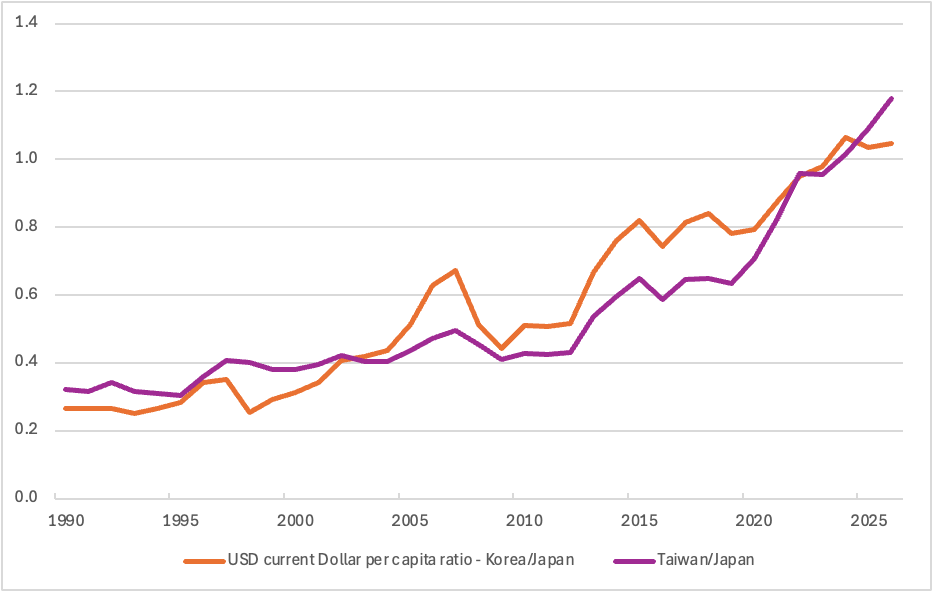
It was TSMC All The Way Post Mid-2000s
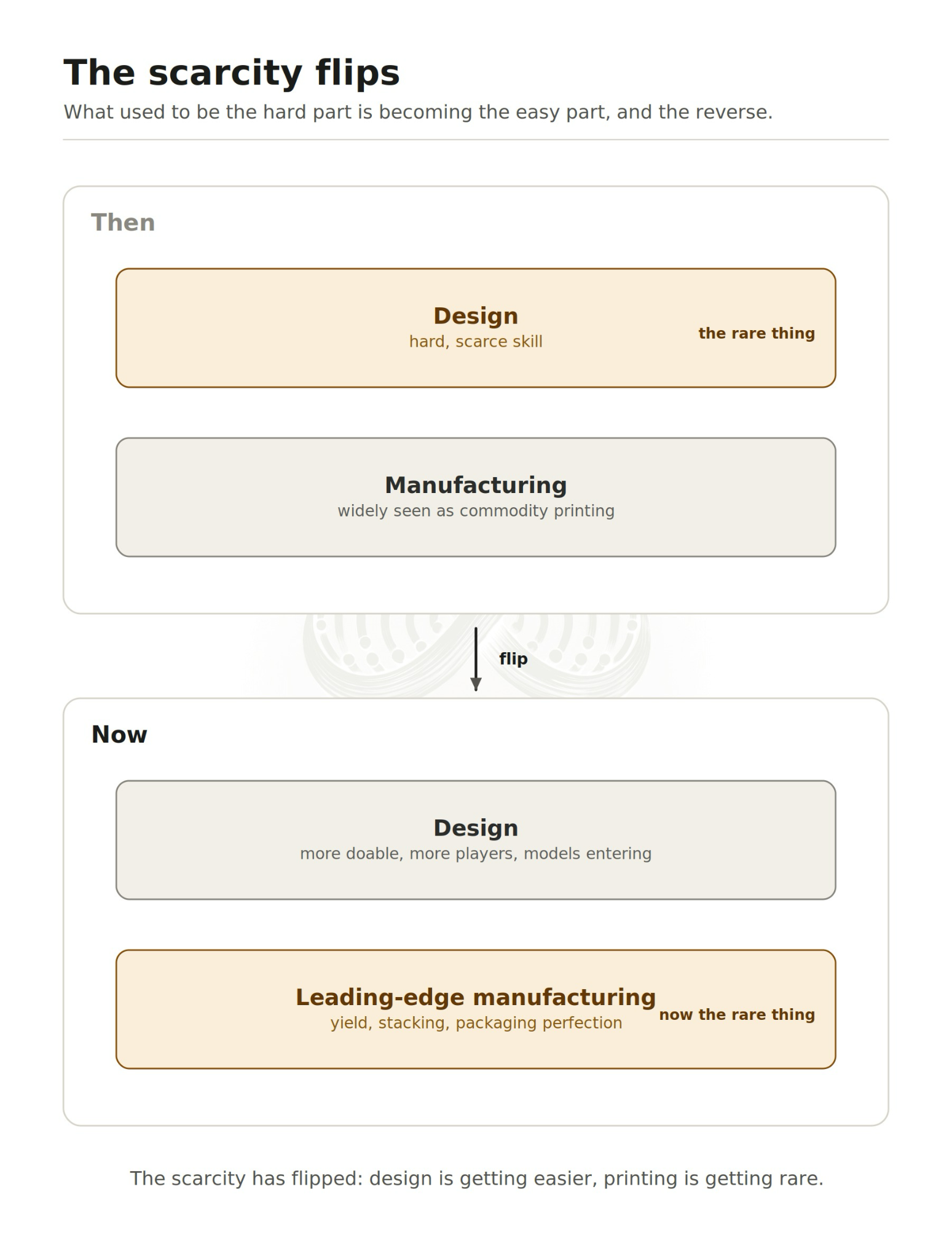
Back to the earliest days of Samsung or TSMC. In somewhat more detail, the question took the form of: when it came to fashioning value on a piece of silicon, which of the two firms did the more valuable work? In Korea, during my time, the answer was not in doubt. Whoever one asked held little regard for what TSMC did, taking another company's design and printing it onto a wafer, set beside what Samsung did in conceiving, designing, and manufacturing its own memory. The consensus in Seoul was broad and confident. Samsung was the finer semiconductor manufacturer, and it was not close.
By the time work took me to a similar head of equity research role in Taiwan in the mid-2000s, the mood was beginning to shift, at least outside Korea. TSMC was emerging as a foundry leader of a kind the industry had not seen, its nearest competitors slipping farther behind with each node. Samsung, for its part, was pulling away from the other memory makers just as decisively. But in Taipei, one could scarcely find a soul who would concede, in a direct comparison, that Samsung's manufacturing stood above TSMC's. This analyst, younger then and inclined to split the difference, first read these hometown verdicts as nationalism, each side unable to see past its own flag.
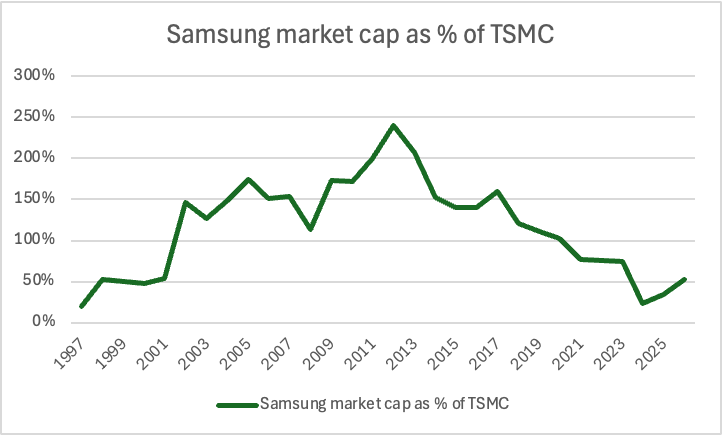
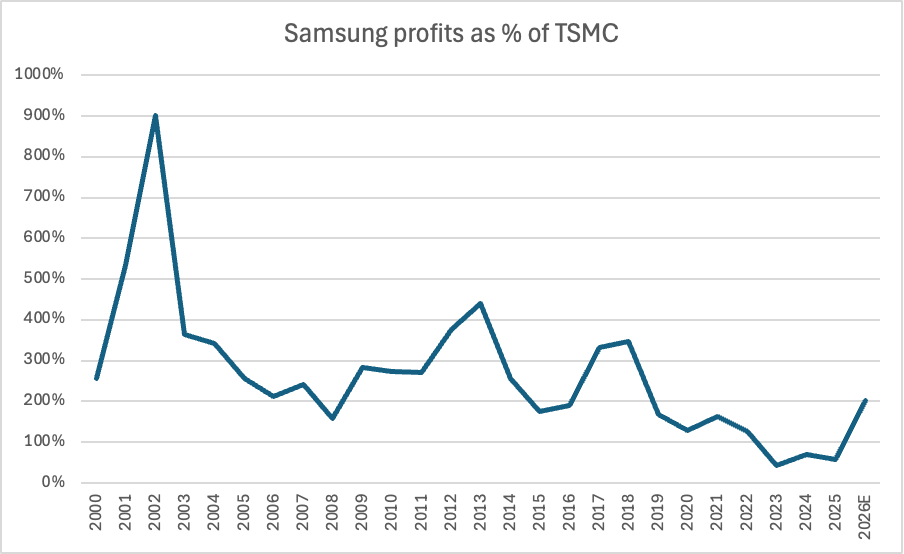
The next 20 years dismantled that charitable reading. What had looked like a rivalry settled into something closer to a one-way race, and TSMC's manufacturing edge established itself not through corporate messaging but through the two numbers that are hardest to argue with, the level of its profits and the calmness of them. It was far worse for Samsung in narratives.
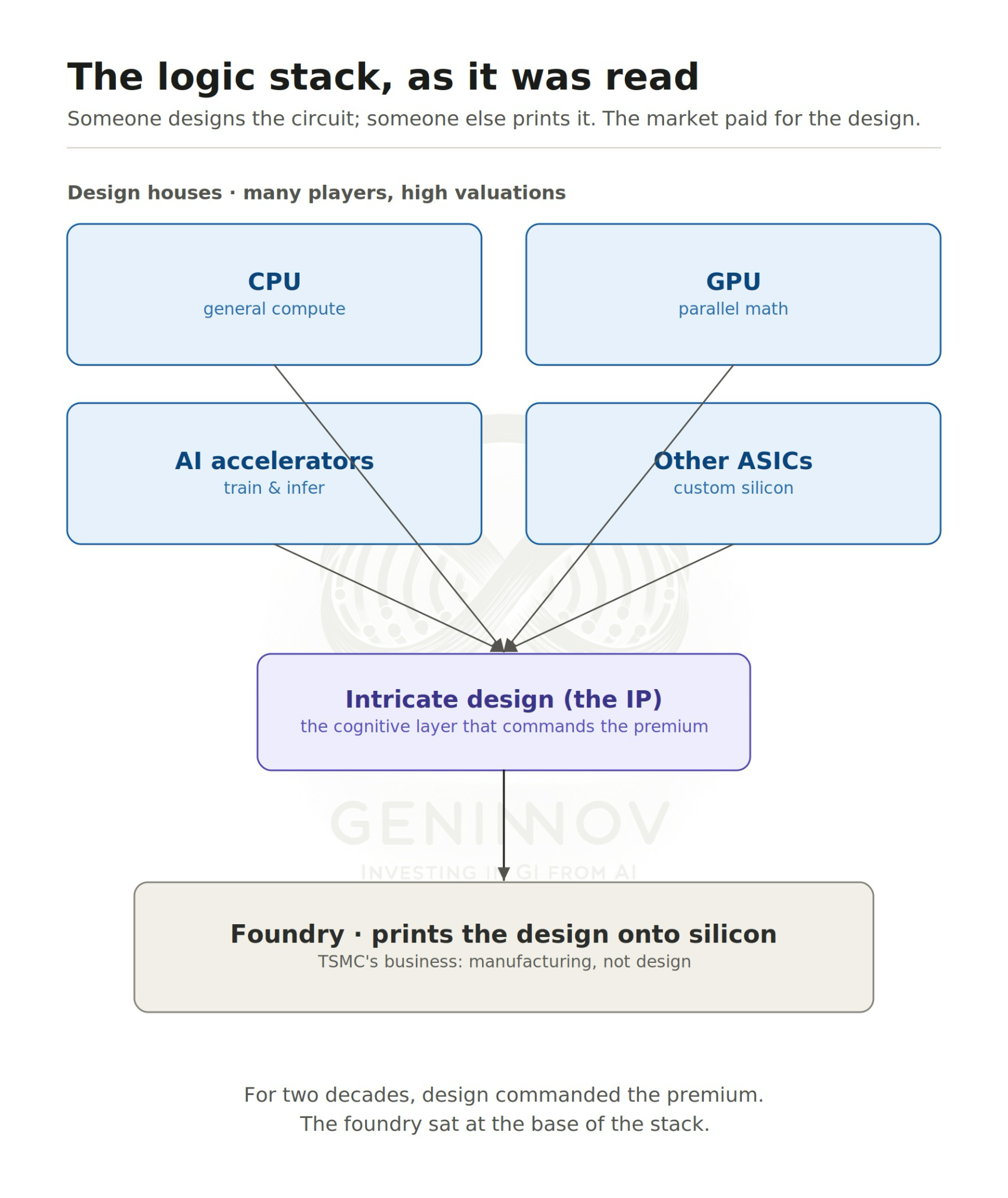
Samsung's work was seen as involving no design layer, as explained below; it was hard manufacturing and little else. TSMC, though it, too, only manufactured, sat beneath an intricate cognitive layer of design that made its contribution appear instinctively more valuable. Its steady financials and profit ratios ratified the impression. TSMC didn’t just win the node race; they won the narrative. The market paid a premium for the printer of thoughts over the builder of vaults.
The scoreboard followed the reputation, and it did so in a revealing order. TSMC first earned a valuation premium; its shares were priced richer than Samsung's. Before long, it overtook Samsung first in market capitalization, and then in profits.
Let’s set aside the history this time, and return to the scratched start of Logicland and Memoryland, before we use the above context for important points.
Before the Generalizations, a Confession
It is almost juvenile to set two companies, let alone economies, side by side and ask which is better. Real life is not a soccer World Cup, where someone must lift the trophy at the end. For an investor, there is often sound logic in owning both, or neither, depending on the season.
So when one calls Taiwan Logicland and Korea Memoryland, one overgeneralizes and knows it. Taiwan is home to fine memory companies. Samsung runs a foundry of real scale. Samsung is not even, as of late, the truest Korean standard-bearer for memory. The schema we blatantly exploit in the following sections flattens all of that.
Why keep it, then? Because it earns its keep in one specific way. It makes visible two shifts that have redrawn the hardware map in barely two years. Since the arrival of generative AI, we have discussed the flip in hardware versus software. In recent quarters, the scales have flipped in design versus manufacturing, a theme we have developed since the real chip-war piece and sharpened only last week in A Chip of One's Own. The schema is to sharpen the implications of the balance shift between logic and memory, where memory's weight against logic, in secular decline for decades, has not merely stopped falling but has begun to climb, and secularly.
The Two Sides of Silicon
When a silicon circuit does work, it splits into two jobs. Logic performs the operations, the arithmetic, and the control that transform data. Memory holds the material that those operations run on, the instructions and the data alike, both the values waiting to be worked on and the results returning from the work.
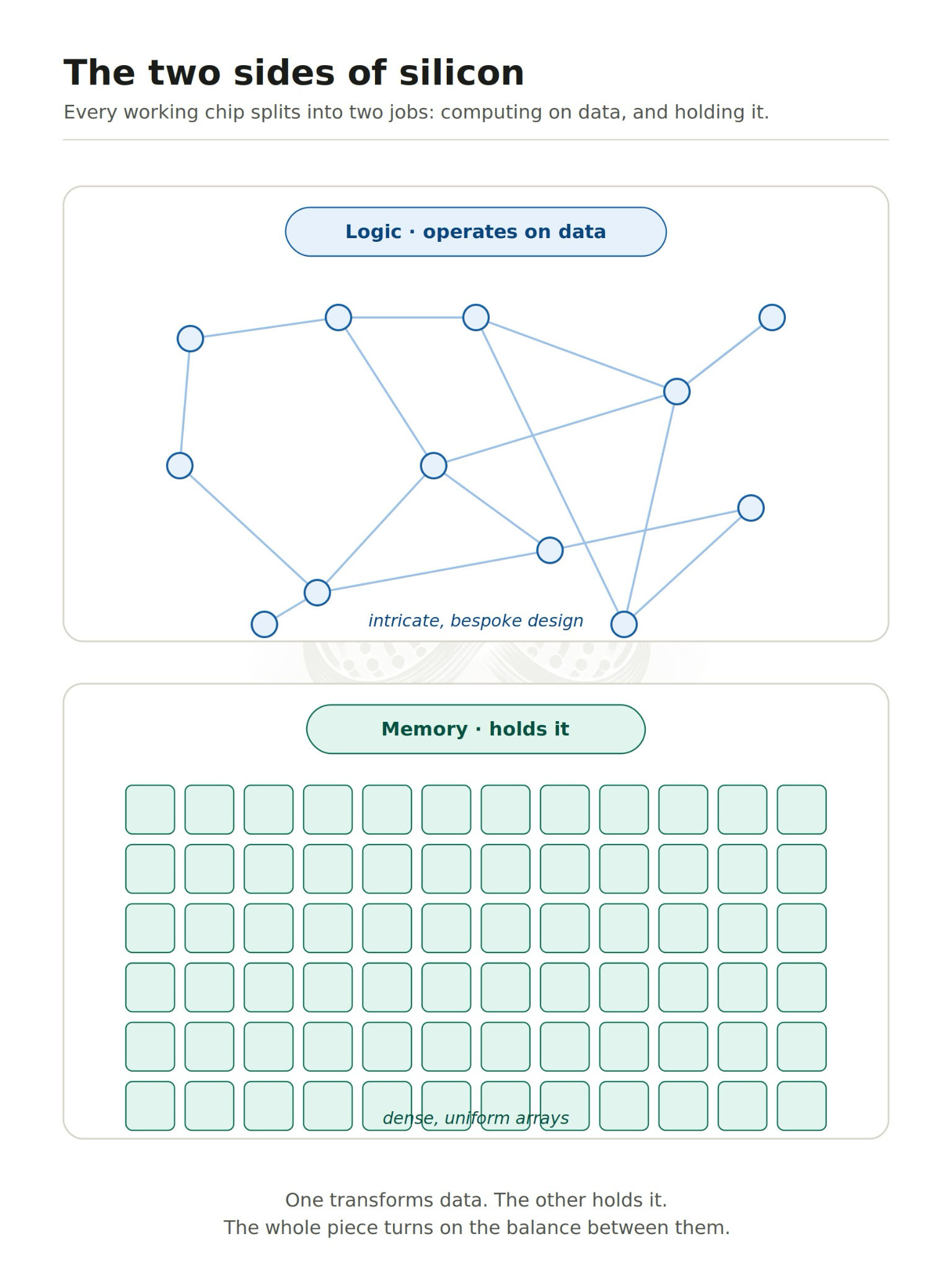
On the logic side, the circuit must first be designed, and the design changes entirely with the purpose. A general processor, a graphics processor, an optical processor, an accelerator built for one narrow task, each demanding a different intricate layout. Many companies around the world do that design. TSMC's business has never been designing. It prints someone else's logic onto silicon, a process that has grown more intricate with every node. Over the decades, the designers rose in complexity, grew in importance and in valuations, and became some of the largest semiconductor names on earth. The foundry sat at the base of the stack.
The instructive part is that the harder skill has begun to move. Design, long the scarce art, is becoming more doable for more players. This is the point we have repeated multiple times, including in last week’s piece titled A Chip of One’s Own. Staggeringly, since the publication of the piece days ago, the design field has moved further, with an LLM, Kimi 3. It ran an incredible, autonomous chip-design experiment where Kimi K3 designed a working microchip from scratch in just 48 hours using open-source Electronic Design Automation (EDA) tools and the Nangate 45nm library.
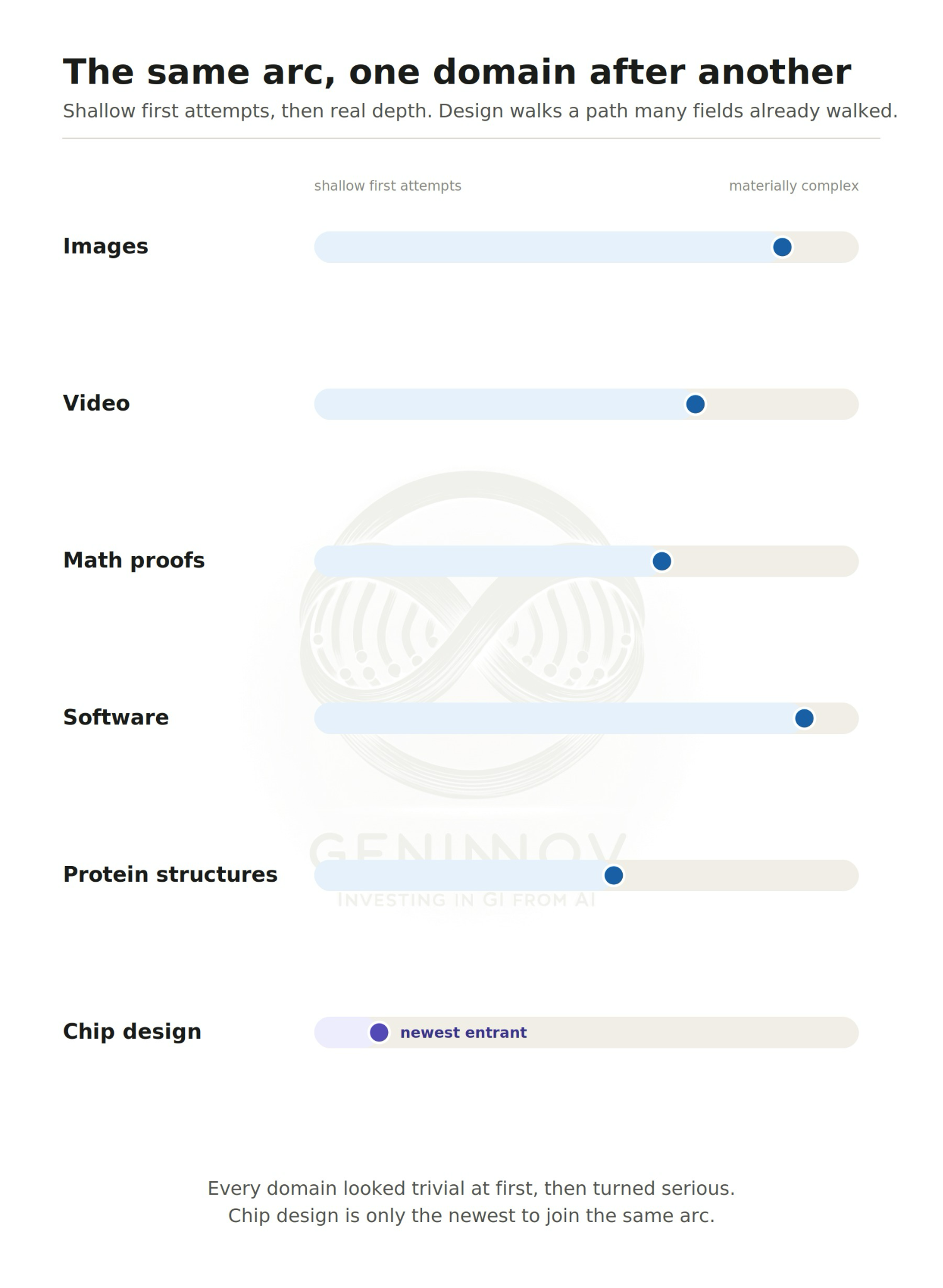
This might be an early proof of concept. Skeptics will rightly say this does not move the needle that much. But we have watched this pattern before. The first attempt in any domain looks shallow and trivial, competitors realize it can be done at all, focus arrives, and the capability turns materially more complex. Even if the first design a model handles is simple in absolute terms, the point is that this was unexpected and from here on, the models will begin their ascent on a new mountain.
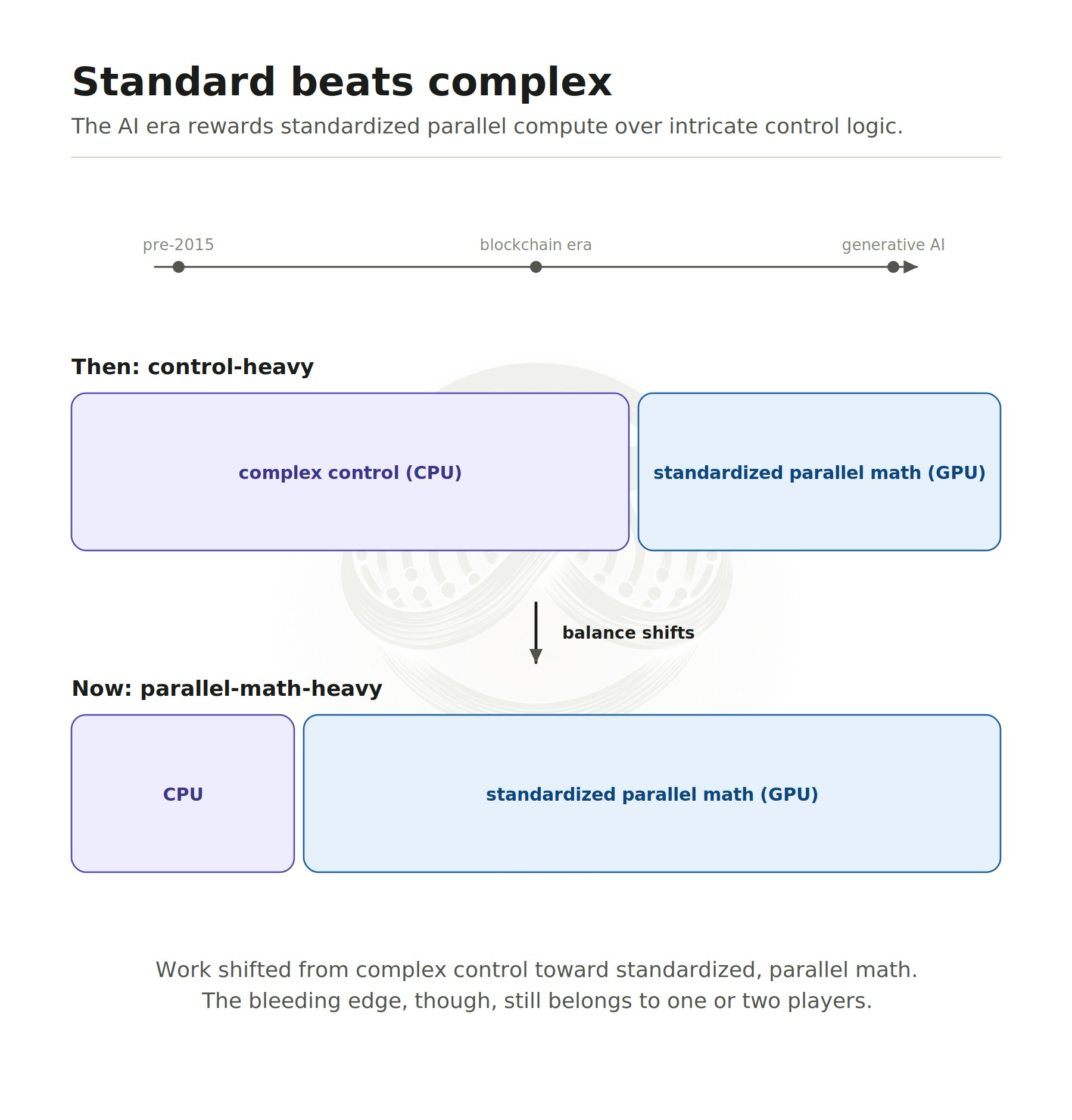
There is a second rebalancing on the logic side, older than the first. The AI era rewards standardized parallel mathematics over intricate control. That preference showed first in the rise of the graphics processor over the central processor, through the blockchain years and then decisively through generative AI, even as the bleeding edge of any given graphics processor design stayed the preserve of one or two players. The main point is that both on logic and memory, generative AI calculations require mass processing on standardized silicon.
When Memory Started to Matter
The deeper shift is not between designer and printer. It is inside the chip, between the two jobs themselves.
Through the pretraining of large models, the processing side did the heavy lifting. Data was consumed, calculations were run, and weights emerged that could later serve as a model. Compute was the constraint. As the center of gravity moved to inference, the picture inverted. Loading the model again and again, moving data, fetching from memory, the work became a matter of memory and interconnect far more than of raw arithmetic. The bottleneck changed hands. For decades, memory was the quiet servant to logic's king. Generative AI inference inverted the court. Today, the processing bottleneck isn't calculating the math; it is fetching the data.
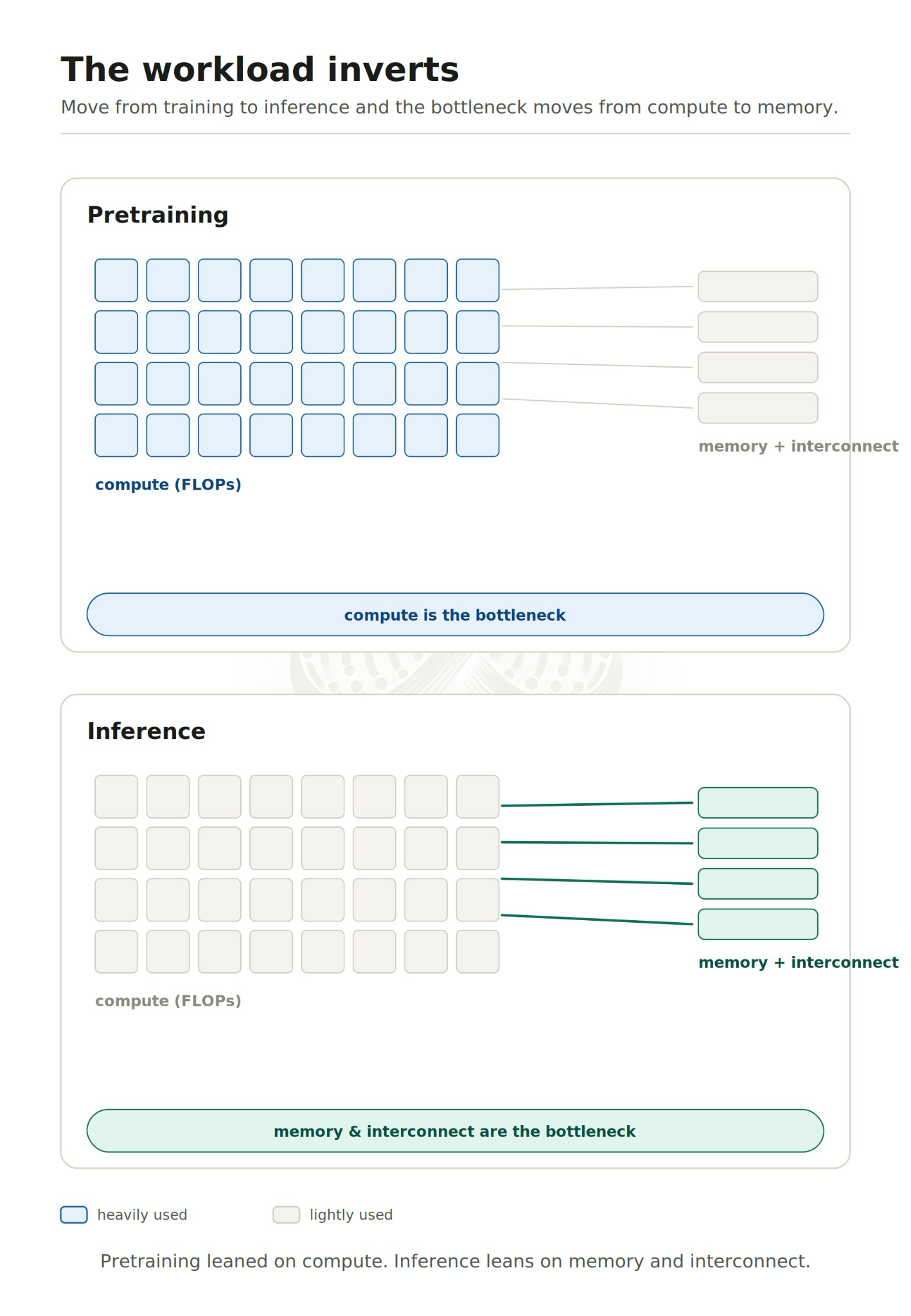
This is the single clearest reason the memory names and the logic names have diverged so sharply over the past year and a half. And it is not a spike. With models intensifying and with the penetration of inference climbing steadily across the world, a theme we have returned to repeatedly, the balance is nowhere near its peak.
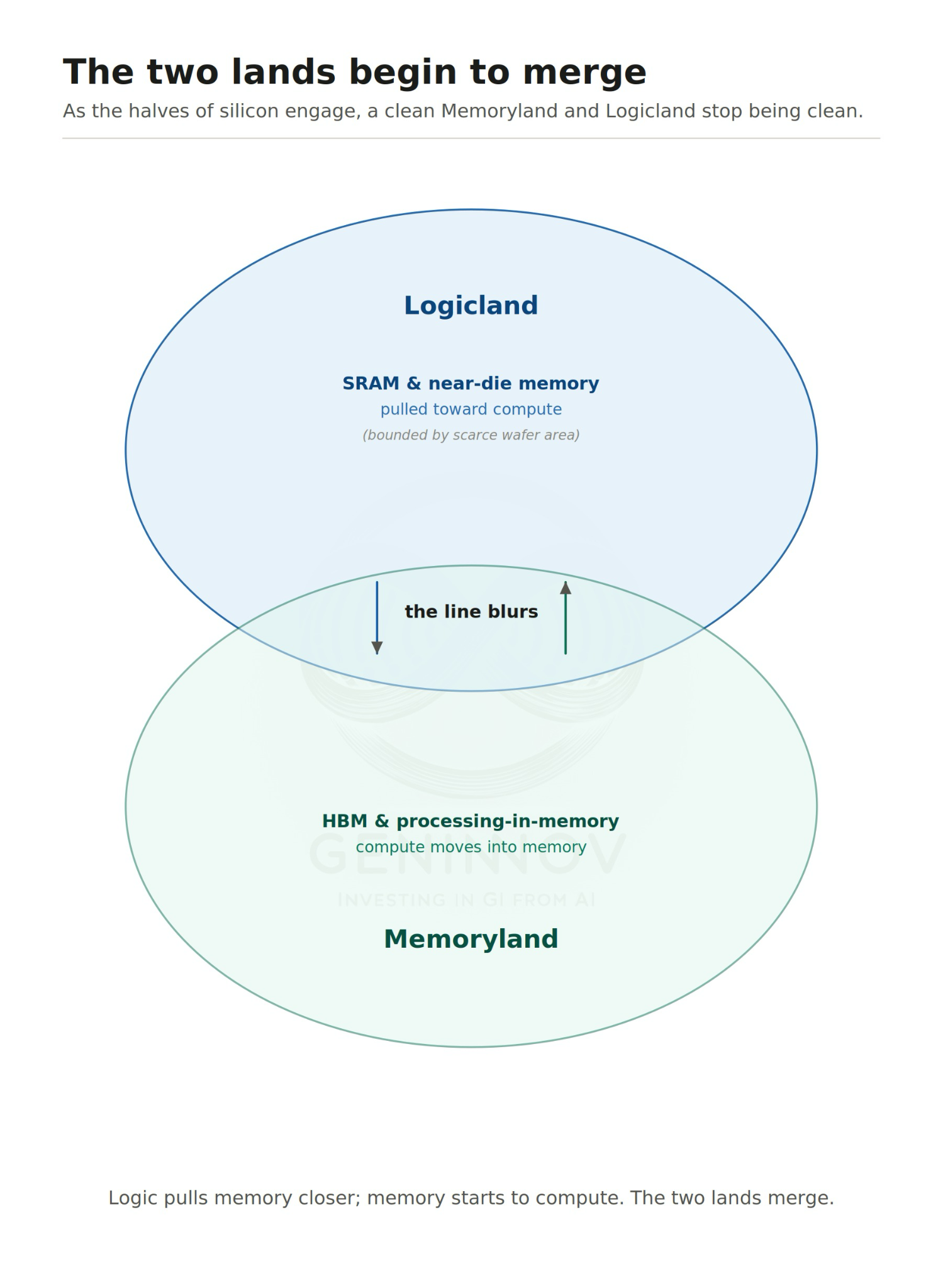
A side consequence is that the two lands are starting to blur. On the logic side, designers pull memory ever closer to the compute through SRAM and other near-die approaches, bounded hard by the plain fact that on-die area is finite and expensive. On the memory side, elementary processing has begun migrating into the memory itself. With high-bandwidth memory and with processing-in-memory, memory is no longer the designless wonder it was taken to be.
The Legolands of Logic and Memory
The cleanest way to feel how complicated both memory-making and logic-making have become is through the struggles of Samsung Electronics in recent years.
We have touched on this before and will keep it simple, but the core point resists simplification. The manufacturing of logic circuits and the manufacturing of memory circuits are two fundamentally different disciplines. To someone far from the field, they look like two flavors of one thing called semiconductor manufacturing. Up close, one is largely about capacitors, stacking and cramming charge into ever-tighter three-dimensional space, and the other is a different regime of etching and deposition built around transistors. Anyone trained in the field knows the textbook of both. The frontier is not the textbook. It is the details, the yield, and increasingly the packaging.
Consider China. Since its national push was formalized around 2014, with the National Guidelines for the Development of the Integrated Circuit Industry and the state-backed investment vehicle widely known as the Big Fund, the country has directed well over one hundred billion dollars into semiconductor manufacturing across more than a decade. It still sits well behind the leading edge. The reason is not a shortage of will or capital. It is that the process has grown less about printing circuits and more about a kind of perfection, the yield on stacking cells densely together, and the mastery of packaging that now decides who leads. This is the world of advanced packaging platforms, of the outsourced assembly and test layer, of high-bandwidth memory, and it is brutally difficult.
And it is not merely a narrative. Samsung struggles on the foundry side, falling repeatedly short of the yields TSMC achieves, and it has lately struggled to keep pace with SK Hynix on the memory side. That a company of Samsung's pedigree finds both frontiers so demanding tells the reader how far those frontiers have moved. Worse, for anyone hoping to catch up, the frontier is racing away because the incumbents are reinvesting extraordinary cash flows not only into more capacity but into the innovation itself. Consider what TSMC is spending to perfect the foundry and to build new packaging platforms, or what Hynix is doing in the next generation of high-bandwidth memory. The gap widens as they run.
The moat, in the end, is not one company. It is the supply and support ecosystem these firms have assembled over decades, the etch and deposition and metrology and test vendors arrayed around them. Anyone starting fresh must contend not with a competitor but with a whole system, and that is a formidable thing to conjure with money alone. Capital can buy lithography machines. It cannot buy a decade of institutional memory.
The same firms are also widening their own scope, which is a source of power in itself. As we argued in Goliath's World and the Encroachment Imperative, the physical layers of the stack are now under the kind of pressure once reserved for software, with the largest players annexing adjacent territory. TSMC in particular is extending its authority into advanced packaging and into the optical and silicon-photonics frontier. Samsung and SK Hynix are not sitting idle either. And as the two halves of silicon engage each other more tightly, the clean division of Memoryland and Logicland is exactly what starts to dissolve.
The Long Way Home
Real life, I said at the outset, is not a World Cup. There is no obligation to crown a winner, and the wanderer who insists on one usually learns better on the way home. After twenty years of chasing the shifting winds of tech valuation, one realizes that the ultimate destination wasn’t a victor, but an understanding of the journey itself.
For this author, the teenage years were spent on matrix multiplication and the early study of neural networks, and even, for one course project, inside a semiconductor fab, printing capacitors onto a wafer. Life then took its long detour. Years went into forecasting where markets were headed on the back of some emerging-market bond yield, in Korea and Taiwan and elsewhere. But the early training never let go, and it kept a quiet interest alive in each new turn of artificial intelligence, neural networks, and silicon.
There is a lesson in reaching the present moment with that particular apprenticeship behind you. When the thematic shifts arrive this thick and fast, the things lately crowned most important, software development one season, chip design the next, quietly take a back seat. What holds the longer lesson is the set of manufacturing processes that are difficult even to understand, let alone to explain without training. Nothing here is settled forever, and there will be cycles. But it is unwise to assume that firms with decades of a very particular expertise, now armed with enormous cash flow, are easily unseated by a well-funded newcomer carrying nothing but cheap capital or state support.
Both nations, of course, are far more than a single word. Taiwan's downstream hardware complex is a marvel in its own right. Korea leads across a wide range of sectors and subsectors, from entertainment to biotechnology. Neither is a monoculture, and neither deserves to be read as one.
The closing thought is this. Most of the flips of the AI era, hardware over software, design against manufacturing, GPUs overtaking CPUs, and now memory versus logic, are perpetually resisted. Taken together, these reversals keep insisting that the generative AI era is fundamentally different from what came before. The belief that undisciplined capital can simply buy a competitive moat is the siren song of the generative AI era. Those who listen underestimate the depth of the waters these incumbents have charted. It is the equivalent of arguing, back in 2015, that because Apple, Google, and Meta earned extraordinary profits, some newcomer somewhere could invest, copy the products, and compete their moats away. What actually secured those profits was the very thing the argument ignored. The same is true of the two lands, and of the firms that built them. That, more than any scoreboard, is the reason they may be far more secure than they look.