The Megaphone Indicator
There is a way to work out which direction markets have been moving without looking at a single price. Watch who is handed the megaphone. When things go up, the optimists get the panel seats and the magazine covers. When things turn down, as they have these past few weeks, the bears who had gone quiet reappear with the full folder, and the folder is remarkably well preserved. Most of what is in it has been in it for three years.
Truth be told, some of the contents have quietly gone missing. Nobody talks much anymore about the statistical parrot, or the university surveys proving that nobody uses AI. They were retired without a funeral. In their place has come rapidly growing Chinese innovation, held up as the threat by the same people who, in the following breath, suggest that their favorite champions should stop spending to meet it.
Beneath the newer complaints, chiefly that today's spending will earn nothing tomorrow, one older fear survives every cycle. It takes a fresh coat of paint each time and reappears the moment the tape turns red. It is the argument about circularity.
The loop diagrams have enormous meme potential, which accounts for half their appeal. The other half is that nobody has been able to dispute the profits of the largest companies, and nobody has produced the forensic report that would settle the matter. So the suggestion gets made obliquely instead. The profits are real, but not the kind that count. A handful of very large companies buy from each other, invest in each other, sign supply agreements with each other and take stakes in each other. Money leaves by one door and returns through another. Sales get booked at both ends. In the harsher versions, the phrase is wash trade, which describes a transaction where nothing genuinely changes hands and everyone involved is manufacturing the appearance of activity.
Underneath the disagreement sits something more basic, repeated here for the umpteenth time. Technology is no longer a sector where money can be made without money being spent. For roughly three decades it was, gloriously so, and an entire investing culture grew up around the fact. Ideas built the moats. Facebook, Amazon, Google and Uber did not need a smelter. That era has closed for most of the large companies, and what replaced it is long-duration capital expenditure, new to technology and about as new to the rest of the world as the wheel. Steel, shipping, refining and airlines have lived on it for a century.
Long-duration capex arrives with a companion that shocks only those who have never met it. Companies in high growth pass through periods of negative cash flow, and even slow-growing ones can go cash-flow negative on a single large project. This is ordinary. The reaction is not. The first time a technology investor sees a rating come down or a cost of debt go up, the response tends to be closer to shrieking than to analysis. Few have had reason to read anything on rating optimization, and so few know that the companies which organize themselves entirely around protecting the highest grade on their debt are the same companies that reliably miss the opportunities that made the balance sheet worth having.
Which brings back the diagram. Somebody with excellent presentation software reads the news, and every time two companies announce anything, another arrow gets drawn. It has become close to a competition between financial publications over whose illustrators can produce the most fearsome tangle. Add an arrow. Add a logo. Mention Global Crossing, or Enron, in a sentence built so that no name and no accusation ever share a clause. The implication does the rest. One day the recession arrives, everyone looks inside the boxes, and the revenues are not there.
A Diagram Is Not An Argument
If anything underneath the loop diagrams were substantially disagreeable, let alone illegal, there is a Pulitzer waiting for the team willing to do the work. The diagrams get published without hesitation. The article that would shake the market and make the day of several politicians never arrives, and it would be generous to assume the reason is caution about litigation.
A tangle is an effective rhetorical device precisely because it looks impossible to undo. Nobody untangles it, and nobody is expected to. The picture does the arguing.
So this piece will attempt the thing that generally does not get attempted. It will take the transaction types one at a time and sort them into two piles. Into the first go the genuinely bad ones, the accounting sins with real names and real histories: revenue with no economic substance, sales that exist only to be sold back, values assigned to things because a number was needed. Into the second go transactions that are complicated, awkward to compress into a headline, and entirely real.
The second pile has grown large, and the reason is not deception. The shape of the industry changed. In the earlier era the roles were clean. Some companies designed and sold the hardware, others built it for them, and a third set wrote the software that sat on top. Today a company that sells chips also invests in the suppliers of the optics that surround the chips, buys manufacturing capacity years in advance, and turns up in a joint venture building the site where the chips will eventually sit. A company that buys the chips also designs its own. A company that sells memory needs the machines that consume it to exist at all. These are no longer buyer and seller. They are four or five relationships running at once between the same two names.
Keep it simple was the finest advice of the elevator-pitch era, and it has been wrong about almost every part of technology for years. Complexity rose because the products became physical, the supply chains global, and the capital expenditure unavoidable. The armchair response is that a business too complicated to be drawn cleanly should not be done at all. Operators do not have that option, and neither, on closer inspection, do their investors, whose job is to unpeel rather than to lament.
The Worst: Where the Loop Is A Fraud
Before deciding whether something insidious is going on, it helps to know what insidious looks like. The fraud being hinted at has a specific anatomy, and once seen it is hard to mistake. Three things must be true at once. Nothing of genuine value can change hands, because the moment something useful is delivered a real sale has occurred and there is nothing left to allege. The flows must be matched and close together in time, because a loop that runs in one direction only is just a purchase. And the price must be set by the need for a number rather than by scarcity, because a market price would be an inconvenience.
Global Crossing and Qwest managed all three. They swapped capacity on fiber that was already buried and already dark, at values the two sides were happy to agree because no third party wanted that capacity at any price. Both recognized revenue. Neither received anything it needed. The trades were near-simultaneous and close to equal in size, which is the signature of the device rather than an accident of it. That is what a loop looks like when it really is a loop.
Most discussed flows of today are lopsided by an order of magnitude. Within circular loops, there is a value-add at every stage. The goods are physical, scarce, and rationed by queue. The prices are set by shortage, which is why they keep rising rather than settling wherever two parties found convenient. And fraud of this shape leaves fingerprints, because it requires two sets of books to agree on a lie. After three years of illustration, nobody has produced one. No regulator, no auditor's qualification, no short seller willing to put a position behind the insinuation.
A Vast Majority in Cash
The modern accusation is tidier than the old one. Company A takes a stake in company B, company B spends on company A's product, company A books the revenue, another arrow gets drawn. Repeat across a dozen names and the picture becomes a closed circuit generating profit from its own motion.
Sales made through investment in a customer do happen, in specific corners, and they get their own section shortly. Almost everything else in the making of this hardware is a cash transfer of a very ordinary kind. Wafers are bought from Taiwan, memory from Korea, land, concrete, switchgear and transformers from whoever pours and winds them, power from utilities that meter it for strangers, and tax from authorities notoriously indifferent to narrative. A closed loop cannot fund a substation. The goods are real, they are scarce, and they are paid for in money on ordinary terms, which is the plainest fact in the argument and the one no arrow has ever been drawn to show.
Not quite everything settles in cash. Some consideration is compute, granted as credit rather than paid as money, and that deserves examination rather than a footnote. What can be said here is that it is disclosed where it exists, and that it is a curious way to run a conspiracy.
The other reason the 2000s comparison keeps failing is that the conditions which made those devices possible have gone. The rules were rewritten to close those specific doors. The people who watched the aftermath now chair audit committees. No auditor signs a barter arrangement dressed as revenue at this scale while the fate of Arthur Andersen remains as vivid as it is. History is not repeating, for the dull reason that everyone in the room has read it.
Paid in Kind
The worry deserves stating at full strength, because it is the only version of the circularity argument with a working mechanism. If a supplier hands a customer something other than money, and the customer hands back an order, the supplier has effectively written its own revenue. The value assigned to the non-cash leg is a judgment rather than a price, and judgments can be nudged until the arithmetic pleases. Lucent and Nortel ran a version of this into the ground in 2001. Wherever fraud is going to live in this industry, it will live here.
The sharpest version of the worry has a shape worth drawing properly. A hyperscaler invests in an AI lab and structures part of the investment as credit on its own cloud. The lab spends the credit training models on that cloud. The investor books the usage as revenue, and because no invoice was ever paid, there is no receivable to age and nothing to reveal a sale that should not have happened. Meanwhile, the equity sits on the balance sheet, and when the lab raises its next round at a higher price, the stake is written up into profit as well. One dollar, entered twice, on two different lines. Amazon's original $8 billion into Anthropic was structured this way partly, and that stake is now carried at more than $70 billion.
Scale settles most of it. Anthropic spent $1.35 billion with AWS in 2024 and $2.66 billion in the first nine months of 2025, against an AWS business running past $100 billion a year, and only a portion of that spend was credit rather than cash. The largest credit-shaped relationship in the industry is therefore worth a low single-digit share of one cloud's revenue. The smaller version, the credit programs that lock in startups and generate a headline every few months, is smaller still. Most of those credits carry no equity at all, and the three big clouds together hand out a few billion dollars a year against cloud revenues approaching $350 billion.
What has changed since is the form rather than the volume, and Nvidia illustrates it best because its numbers are the largest and its disclosures the most granular.

There were two issues with investments from accounting and disclosure viewpoints: investments in customers and investments against revenues. And, both have gotten materially duller in recent quarters compared to early 2025. One because of the increased discussion around the propriety of such transactions and the other due to the Silicon Shock.
Last September, Nvidia announced an intent to invest up to $100 billion in $10 billion increments as OpenAI brought tranches of datacenter capacity online, and this agreement was perceived by many as a clear case of investments against revenues not paid in cash. Likely because of the scrutiny, that agreement was never sealed. What replaced it was smaller, plainer and unconditional: a $30 billion investment not tied to any deployment milestones. The conditional, capacity-linked, headline-generating version died. The boring one survived.
Still, in the above table, the totals are plainly getting larger. What has changed alongside them is direction. The bulk of the recent money has gone up the supply chain rather than down it to support customers, as we discussed in Nvidia’s sprinklers. One can argue whether a company generating enormous cash should sit on a cash pile, return the excess cash to shareholders via dividends or buybacks, or invest in the supply chain given what it sees as opportunities based on its vantage point. However, none of these are accounting irregularities hinted.
It is worth noting that an investment in a supplier, as against a customer, is the opposite of the accusation. It is capital going toward capacity that does not yet exist, placed by the party with the best possible view of whether that capacity will be needed, since it is the one that will be buying the output.
Marked to Market
Here is where the skeptics should have been standing all along. In the June quarter, Alphabet recorded $99.0 billion of gains on equity securities, nearly all unrealized.They contributed approximately $6.26 of its $9.11 in diluted EPS. Amazon reported $53.4 billion of total non-operating income against $80.9 billion of pre-tax income; within that total, $50.5 billion represented upward revaluation adjustments to private-company investments, primarily Anthropic. For Nvidia, equity gains were 23% of pre-tax, although 80% came from holding public-market equities.
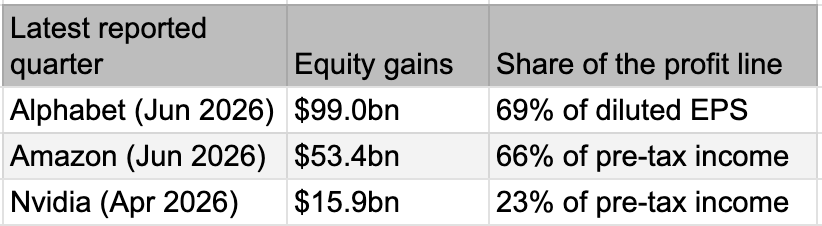
The objection writes itself. A valuation set by the newest investor in a private round is not a price discovered in a market, the gain reverses as easily as it appeared, and the tax on it is real even when the income is not. The public holdings are worse in one respect, since they are marked against a live screen and will swing hard in both directions, which means reported profits at several of these companies now carry a beta to the very market that is reading them. Microsoft makes the point neatly by accident: the same OpenAI stake produced $2.7 billion of net losses in one nine-month period and $5.9 billion of net gains in the next.
Which is exactly why none of this is the thing the loop diagrams have been alleging. Every figure above is measured under a rule that permits no election, disclosed on its own line, and separated from operating income by the width of the page. The companies themselves hand out the adjustment. Nvidia's non-GAAP presentation strips out gains and losses from both non-marketable and publicly held equity securities, which is why its April quarter showed $2.39 of GAAP earnings per share and $1.87 without them. An investor who dislikes the marks can remove them in one subtraction and look at operating income. An investor worried about the balance sheet can do the same there.
In simpler terms, the investments of the largest technology giants, increasingly including those from Asia, are now a substantial part of their valuation. Some may want to apply holding company discounts, and others may have their own methods for the fair valuation of the holdings. However, none of these are disclosure issues.
Guarantees, Buybacks and Other Old Ideas
Six instruments get drawn as one arrow. They carry different risks, and every one of them has been in use somewhere else for decades.
Start with buyback guarantees. Nvidia agreed last September to absorb CoreWeave's unsold capacity through 2032, worth $6.3 billion at signing, renting back unused GPUs at a fixed rate for a share of the upside. AMD offers the same to AWS, Oracle and others. This is a residual value guarantee, the thing automakers write into every lease book and aircraft makers give launch customers. Publishers take back unsold books, which is why a bookshop stocks a novel it doubts. The manufacturer carries the residual risk because the manufacturer prices it best. Nvidia decides what replaces a used GPU, so Nvidia knows what a used GPU is worth.
Then lease guarantees. Google guarantees Fluidstack's obligations at all five of its US sites so the landlords could borrow against them. Nvidia discloses $3.5 billion of similar exposure, taking warrants in return, with $712 million of partner money in escrow. Anchor tenants have guaranteed leases since shopping centers were invented.
Then offtake. CoreWeave's $99.4 billion backlog includes roughly $21 billion from Meta to 2032, and lenders underwrite the contract rather than the borrower. Its Meta-backed facility priced near 5.9%, about 90 basis points over Meta's own yield, against unsecured bonds nearer 10%. No LNG terminal, bulk carrier or mine is ever financed differently.
Then prepayments, which are the most conservative item in the whole debate. Cash arrives, sits as a liability, and becomes revenue only as capacity is delivered. Shipyards and Boeing have run on progress payments for a century.
Money also runs upstream, which the diagrams rarely show. Intel is protecting its substrate suppliers' profitability through the EMIB-T ramp while early yields run near 50%, with Unimicron in mass production from 2027 alongside Ibiden and Shinko. That is risk transfer, not financing: the customer absorbs the cost of the supplier's learning curve because it needs that curve climbed. Intel can ask for the position because Google is said to want 12 to 15 million TPUs in 2028, beyond what TSMC can supply.
Finally, equity in the channel. Nvidia added $2 billion of CoreWeave in January and $2 billion of Nebius in March. Captive finance is the older name. General Motors owned GMAC, Deere owns John Deere Financial, Caterpillar owns Cat Financial. A manufacturer whose product costs more than its customers can pay in cash ends up in the finance business every time.
The common thread is plain. Profits have concentrated in a few companies that depend on links which cannot fund themselves fast enough. Someone with the money and the visibility fills the gap and charges for it. Any manager in a capital-heavy industry recognizes that as business development spending. If a company stands to make a great deal of money provided some critical part of the chain exists, paying for that part to exist is arithmetic, not deception.
Rivals, Partners, Customers
The old map was easy to draw. Microsoft had enterprise software, Google search, Amazon ecommerce and cloud, Apple devices, Meta social media, Nvidia graphics processors. They trespassed at the edges, but each held a kingdom.
That map is disappearing. A modern AI project needs capital, chips, memory, advanced packaging, power, land, models, manufacturing capacity and, increasingly, sovereign goodwill. No giant controls all of them. So the unit of competition is shifting from the company to the project. Companies assemble around a particular build, contribute what they possess and may disperse when it is finished. The same two names can be supplier, customer, financier, shareholder, co-developer and competitor at once, with the mix changing from one project to another.
This is not friendship breaking out. It is rising entanglement, forced by scale and dependency.
The resulting announcements are not all the same animal. Microsoft and OpenAI have had binding arrangements covering cloud capacity, intellectual property and revenue sharing. Stargate is a project coalition, with SoftBank carrying financial responsibility, OpenAI operational responsibility, and Oracle, Nvidia, Microsoft and Arm occupying various technology roles. Nvidia and SK hynix are aligning supply with the co-development of future memory. Samsung and Broadcom have signed a memorandum of understanding.
Yet the numbers attached to these different forms can all sound equally concrete. Samsung and Broadcom described more than $200 billion of collaboration across memory, foundry and packaging through 2030, although the instrument remains an MOU. SK Group and Nvidia announced a partnership exceeding $500 billion in July, while signing letters of intent. Stargate’s $500 billion is what the project intends to invest. These may become enormous commercial relationships, but an intention, a reservation and a purchase obligation are not the same thing.
Nor do binding partnerships remain fixed. Microsoft and OpenAI once looked like the industry’s most durable alliance. It has already been rewritten more than once. Microsoft’s license is now non-exclusive, while OpenAI may serve customers through other clouds. In this world, even long-term alliances come with dates, boundaries and escape routes.
This is what the circular chartist misses. A dollar can travel in a circle while assets, risks and bargaining power do not. At the end of a project, one party may own the data centre, another the chip architecture, another the model, and another a long-dated obligation to buy capacity it may no longer need. The arrows look symmetrical. The outcomes are anything but.
The chartist can also make the reverse error, counting an MOU, an equity investment, a capacity reservation and a guaranteed purchase as equivalent arrows. They are not equivalent in law, cash or consequence.
The work, therefore, is to ask who commits the capital, who owns the asset, who carries the utilisation risk and who can walk away. The relationships are not merely circular. They are multidimensional, temporary and increasingly unavoidable.
Living With Complexity
We like simple explanations. We want conclusions, bullet points and villains. The desire is understandable. It is also dangerous. AI has made technology more capital-intensive. And, this capital-intensive technology world is now genuinely hard. Model making is hard. Hardware is hard. Building the infrastructure underneath both is harder still. None of it reduces to a slide. Complexity is no longer an inconvenience. It is the subject.
A loop diagram is easier to absorb than hundreds of pages of contracts, disclosures and technical detail. It hints at impropriety. It travels well. But it is not investment analysis. The economics lie in the details: who commits the capital, who owns the assets, who carries the risk, and who can walk away.
Plenty here will still go wrong. Projects will disappoint. Returns on capital will be lower than the builders promise. Some of the money now being spent will not come back. That is what a buildout of this size means, and it has been true of every one that came before. But none of it will happen because a disclosure was withheld, or because something illegal was buried in a footnote. It will happen for the ordinary reason that hard things are hard. In capital-intensive activities, business risks are a part of life. An armchair loophole artist may seek a world without entanglements, but this is akin to someone wanting to be a quantum physics expert without equations.
The information is there for anyone willing to do the work. Read the agreements. Study the disclosures. Understand the technology. Judge each project on its economics. There may be no scandal hiding underneath. That is not a viral conclusion. It may still be the correct one. Complexity is not a defence. But simplicity is not analysis.