There is a specific kind of catastrophe that masquerades as corporate prudence. Three years ago, when the foundation model era broke open, the world's most powerful institutions looked at the chaos and chose to wait. They assumed the technology would soon hit a wall governed by rigid scaling laws, or that it was a hyper-competitive sprint they could simply buy into later once the commercial applications became obvious. They demanded visibility. They wanted a map for a continent that was still rising from the ocean. Today, the cost of that prudence is a near-permanent exile. The organizations and nations that opted out of the model-making journey in 2023 are now locked out entirely, relegated to the same permanent structural dependency as countries that cannot print their own advanced semiconductors. The door has shut, and they are standing on the outside, while the latest generation models could help their rivals attack their most cherished infrastructure.
It is perhaps too much to ask senior leadership to stand before a board of directors or a parliament and admit that a demand for strict ROI was actually a fatal failure of imagination. But privately, that reckoning is existential. The history of the last three years proves that the nature of this technology fundamentally defies the central planner. In systems where scale drives emergence, you cannot possibly see where you are headed. The terrain builds itself under your feet only as you walk. The early model-makers did not possess a secret roadmap. They simply possessed the nerve to step into the dark and let the computational process compound. Any institution that relies on a committee of senior planners to dictate strategy based on current visibility and neat calculations is actively putting its own survival at risk.
We must study this recent history because the exact same mistake is being made again, right now, on an even wider scale. Having missed the foundation layer, these identical institutions are approaching the agentic workflow transition with the identical lethal caution. They are demanding precise productivity forecasts for agentic pilots and asking exactly where workflows are headed before allowing their organizations to adopt the tools. This piece is an autopsy of the model-making misjudgment. It is offered not as a historical critique, but as a mirror, so that we might recognize the true cost of our own prudence before we price ourselves out of the future a second time.
The Physics of the Unplannable
A single water molecule possesses neither temperature nor pressure. You cannot isolate a hydrogen atom, place it under a microscope, and locate the concept of wetness. Wetness does not exist at the component level. It is a property of scale. A solitary neuron does not calculate, plot, or dream. But wire a hundred billion of them together, and the architecture hallucinates reality. This is an emergence. It is the phenomenon where quantitative accumulation suddenly triggers a qualitative leap. One plus one does not equal two. One plus one equals an entirely new physics.
Biologists, physicists, and urban theorists have understood emergence for a century, although many theorists have philosophical qualms with the term, given the mystique it introduces. However, almost every practicing scientist knows that numerosity and complexity can lead to new properties one cannot foresee while studying the constituents. One cannot study the original transformer equation to any degree to somehow forecast the arrival of models with the abilities we see today.
The tragedy is that it remains fundamentally alien to the corporate boardroom while thinking about “AI”.
The modern executive, whether in a corporate or a country planning setup, is conditioned to be an engineer of outcomes. The entire architecture of institutional management is built on the theology of the blueprint. You specify a feature, calculate a budget, model the return on investment, and hold managers accountable for delivery. Software was built this way. Supply chains were built this way. It was entirely rational for these leaders to assume foundation models, and now agentic workflows would be built this way too.
They made a profound category error. They confused a system whose useful properties are engineered with a system whose useful properties emerge.
The traditional manager looks at an agentic AI pilot and asks what exact workflow it will replace and what the precise margin expansion will be. The emergent thinker asks a completely different question. They ask what constraints must be removed, and what data must be fed into the system, to allow high-value behaviors to spontaneously arrange themselves. The traditional manager demands the conclusion before authorizing the budget. The emergent thinker understands that the entire point of the technology is to produce conclusions nobody in the room was smart enough to specify in advance.
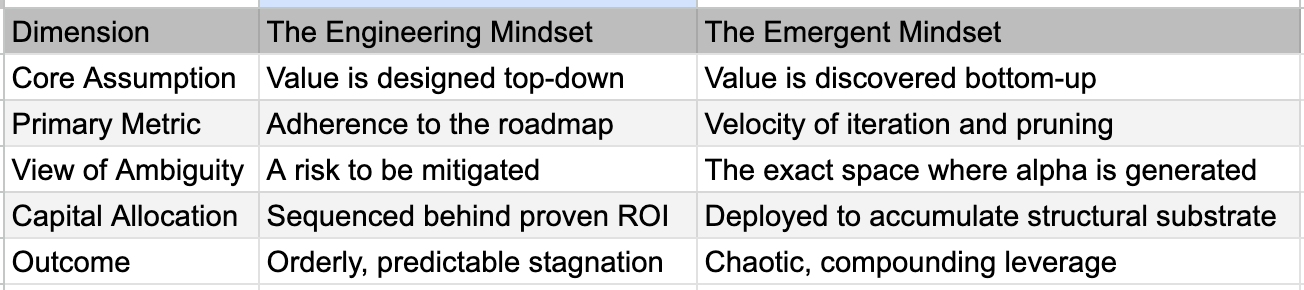
Of course, no seasoned leader actually needs a lecture on the unpredictable power of compounding forces. Any executive who has built a global business understands that evolution resists a master plan. You cannot extrapolate the reach of an empire from the blueprint of its first storefront, just as you cannot forecast the mind of a maestro from the heartbeat of an embryo. In the messy reality of markets, human behavior, and organizational culture, leaders accept that plans mutate. They know that forces evolve.
This humility applies to almost every domain of leadership, with one fatal exception. When it comes to technology, the executive mind snaps back to the drafting table.
Because technology is built by engineers, the people who fund it assume it must behave like engineering. They look for the definitive endgame. They search for the saturation point. When presented with early, chaotic AI models, they reflexively applied the mental models of software procurement. They assumed that because the system was constructed from math and silicon, it would eventually conform to a neat, predictable boundary, perhaps dictated by a simplistic reading of scaling laws. They waited for the models to finish baking so they could buy the finished product.
This is not an abstract theory. It is the exact mechanism that determined the winners of the foundation model race. At the GPT-3 scale, models could string together coherent paragraphs. At higher scale, reasoning, coding, tool-use readiness, instruction-following and self-correction became dramatically more reliable without being hand-coded as discrete software modules. The reasoning was not a specified feature. It was a phase transition. The labs that won were the ones that recognized they were cultivating a phase transition rather than writing software. They let the computational substrate compound. The corporations and nations that paused, demanding to see the architectural blueprint for artificial reasoning before committing their capital, are now permanently dependent on the believers.
The Substrate and the Illusion of Portable Genius
There is no salvation in studying the model-making collapse merely to assign blame. For those who missed the foundation window, the exile is absolute. The value of this autopsy lies entirely in the fact that history is offering a terrifyingly precise repetition of the test. The exact same emergent dynamics are now dictating the agentic workflow transition, where the window for accumulating substrate remains briefly open. Understanding how the central planners failed yesterday is the only way to stop them from procuring themselves into irrelevance today.
There is a fundamental difference between a skill-dependent field and a scale-dependent ecosystem. If a nation or a corporation wants to build the finest symphony orchestra on earth, it can afford to be late. It can wait for the genre to mature, study the acoustics, and then simply buy the world’s best violinists. In a skill-dependent field, talent is portable. Late entry is not merely possible, but often economically desirable.
Model-making is not a symphony. It is an ecosystem. And in an emergent ecosystem, a genius stripped of their environment is powerless.
This is the cold truth that explains why the organizations that opted out in 2023 can no longer buy their way back in. They told themselves they were being responsible. They planned to wait for the chaotic early days to settle, for the cost curves to bend, and for the single-dimensional scaling laws to hit a ceiling. Then, they reasoned, they would simply hire the talent, buy the compute, and compete from a position of absolute clarity.
The clarity never arrived. What arrived instead was a compounding recursion.
Take the early scaling laws. In the strictest sense, they were mathematically correct about the things they bothered to count. They accurately described how pretraining loss scaled with parameter counts, token volume, and raw compute. But the observers made a fatal error. They assumed those three variables were the absolute boundaries of the technology. They looked at parameter counts and confidently proclaimed various kinds of saturations. They measured what was legible. They missed what was vital.
The Importance of the Journey
While the critics were watching the parameter curve flatten, the labs at the frontier realized the system was generating new, invisible dimensions. The models themselves became the factories for their successors. DeepSeek did not scrape the web to train V3; it explicitly distilled the reasoning traces from its own R1 model. Anthropic did not just hire human labelers; it used ancestral models to constitutionally judge and refine the next generation. The frontier now scales across nine axes, not three. Six of these newer dimensions are entirely invisible to the outside world, compounding in the dark, impossible to acquire through a vendor contract.
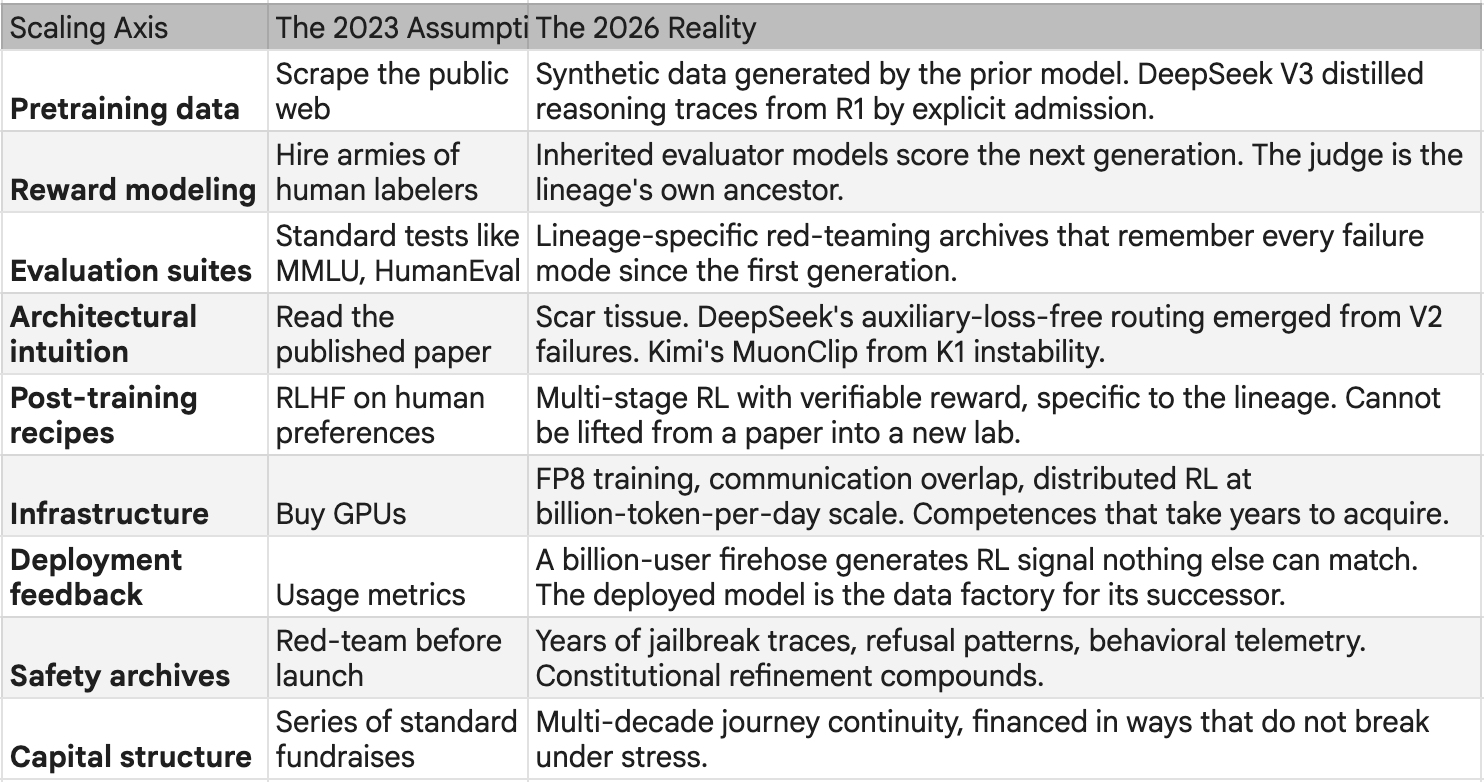
The cleanest summary of the current landscape is this. The original laws measured what was easy to count. The frontier now scales what is hard to count and impossible to buy. The gap between the leaders and the laggards is no longer measured in parameter counts. It is measured in the depth, trauma, and coherence of the lineage.
Meta proves this point with brutal clarity. Meta possesses infinite capital and, more importantly, understands the need to remain in the race with an urgency missing with many others. Meta has assembled what is widely reported to be the most expensive AI research roster ever built. Meta operates clusters with more than 100,000 GPUs. And yet, Meta still cannot ship its Behemoth model at the quality bar its own engineers demand. You cannot leap from a dense Llama 3 architecture to a two-trillion-parameter Mixture-of-Experts behemoth in a single bound. The researchers need the intuition forged in the fires of intermediate failures, tempered by the relentless, chaotic demands of live users stressing the system at every foundational step.
A late start is fatal not because you lack the compute, but because you arrive with an obsolete artifact that commands no audience. Without users willing to push a dated technology to its breaking point, you are starved of the unforgiving deployment feedback required to synthesize the next generation's training data. The compounding engine of scale starves, and the lineage stalls entirely.
The story repeats across the industry. Mistral boasts brilliant founders and respectable funding, yet has not produced a closed-frontier general model to match the leaders. xAI built the largest single-site cluster on earth but trails on complex coding benchmarks while grappling with the departure of tired co-founders. Capital alone fails. Talent alone fails. Compute alone fails. The substrate is what survives.
Early Movers’ Oligopoly
The internet era taught us that early movers often turn into runaway monopolies, a dynamic that seemed to be fading in traditional software. It has reasserted itself violently in model-making for a specific reason: to take the next step, you must stand on the precise artifact created by your own previous step.
As a result, the club capable of reaching the next frontier has contracted permanently. This shrinking oligopoly is the foundational structural fact of the global economy for the next decade. Beyond the narrow list of recognizable names, the road is structurally blocked.
There is a vital distinction here that the market consistently misunderstands. The visible frontier is not the real frontier. The models the public uses are historical artifacts. They are snapshots of capabilities the labs mastered internally one or two generations ago. Downloading an open-source weight file is downloading a fossil. You get the bones. The living, breathing animal stays locked behind the closed doors of the lab.
The financial and geopolitical cost of this misjudgment is now bleeding into the real economy. It is appearing in national current account deficits widening to fund foreign inference. It is compounding in productivity gaps across traditional industries. It is hindering the innovation paths of those without comprehensive access in sectors from drug discovery to materials science. Nations are quietly restructuring their sovereign defense budgets to pay American or Chinese vendors for the cognitive access required to ward off automated threats.
The corporate and national opt-outs were not wrong about narrow mathematical scaling. They were fundamentally wrong about what scaling actually meant.
Agents: The Second Test of Scale-Dependent Evolution
There is a distinct, agonizing rhyme to the skepticism surrounding agentic workflows today. Two specific complaints echo perfectly from the early, chaotic days of foundation models. First, there is a pervasive frustration with the sheer clunkiness and unreliability of current enterprise agents. The pilots stall. The workflows break. The agents get trapped in reasoning loops or confidently hallucinate API calls. The boardroom reaction carries the exact same smug dismissal we heard two years ago when critics mocked early large language models for failing to count the number of 'r's in the word "strawberry."
Second, many leaders continue to wonder what all the agentic fuss is all about. They cannot find anyone discussing worthy projects with them. They cannot make themselves agree to projects with no end goals; all they see is no immediate, bulletproof use case that justifies the massive structural adjustments, data engineering, and sheer capital required to scale it. They want a pristine, high-ROI application to justify the budget before they commit to the infrastructure.
The model-making mistake was tragic, but it was physically confined to the lab floor of a few massive corporates and a handful of sovereign nations. The agentic mistake is currently being made at the organizational level by nearly every delaying corporate and government entity on earth. The conceptual failure is identical: demanding visibility before commitment in a domain whose entire value is derived from emergence. Patriarchal systems attempting to run an agentic transformation as a standard, master-planned software procurement project will produce a sterile, perfectly compliant system that generates absolutely zero alpha. The corporate that focuses instead on setting conditions, removing constraints, and aggressively pruning dead branches will build a compounding engine of cognitive leverage.
The concrete proof of this dynamic is already highly visible on the developer floor, where the agentic transition started earliest. Look at Claude Code, Cursor, Devin, GitHub Copilot Workspace, and a dozen other specialized agent harnesses. They all utilize the exact same underlying base models. Yet, they end up producing radically different, highly idiosyncratic developer workflows. The differentiator is not the model. The differentiator is the agentic configuration wrapping the model. How the agent accesses local tools. How it maintains context memory. How it recovers from hallucinations. How it handles the friction of handing tasks back to a human.
None of these configurations were designed on a whiteboard in advance. All of them emerged purely from the friction of use. The teams that shipped early observed what worked, pruned what failed, and iterated the architecture. The teams that waited for the landscape to clear are now forced to buy software from the teams that stepped into the dark.
The Epigenetics of Agency
It gets far more complicated than the evolution generated through scale-progress in model-making. To understand why these workflows cannot be mapped in advance, one must view agents not as software, but as epigenetic systems. In biology, the genome provides the static code, but the environment determines which genes are activated, silenced, or expressed. The final organism is a product of that dynamic interaction, a phenotype that cannot be predicted by reading the DNA sequence alone. An agentic deployment functions exactly the same way. The foundation model is merely the raw genetic material. The corporate environment, the unique telemetry of its databases, the unwritten quirks of its operations, and the specific friction of its customer touchpoints are the environment that alters its expression. When you mix a reasoning model with a specific institutional habitat, you trigger a behavioral evolution that completely defies top-down forecasting.
Because this evolution is environmental, the earliest developers are not just optimizing existing processes. They are charting radical discontinuities. Trying to forecast what an agentic organization will look like by looking at today's workflows is like trying to forecast the global financial architecture of the internet age by looking at a digitized ledger in 1995. The transformation does not merely automate the teller; it renders the physical branch obsolete. We are already seeing the first expressions of this shift. In logistics, organizations are moving past simple route-optimization software toward autonomous supply-chain networks that dynamically renegotiate vendor contracts and reroute freight in response to geopolitical whispers, long before a human manager even notes the disruption.
Consider the quiet restructurings currently unfolding across the corporate landscape. In clinical research, multi-agent networks are not just drafting reports; they are autonomously synthesizing patient data, cross-referencing global trial failures, and adjusting active molecular modeling hypotheses overnight. In enterprise finance, the traditional quarterly audit is being replaced by continuous, autonomous forensic agents that intercept billing anomalies at the transaction layer rather than reconciling them months later.
These are not incremental software upgrades. They are entirely new institutional species. The organizations watching from the sidelines, waiting for these configurations to mature into neatly packaged vendor products, will eventually purchase the tools. But they will find that the software is empty without the years of environmental training data that their competitors accumulated while living through the evolution.
The divide that separates the winners from the exiled is ultimately a crisis of culture. On one side are the institutions attempting to "do" AI through steering committees, meticulous project roadmaps, and endless alignment meetings. They treat the technology as an administrative problem to be solved by the bureaucracy. These executives waiting for the perfect vendor solution are trapped in an extrapolation habit. They take the linear progression of enterprise technology from the last three decades and project it blindly forward. They assume agentic AI is simply SaaS with a reasoning engine, a product that will eventually mature, commoditize, and go on sale. This fundamentally misunderstands what scale-dependent evolution is. Software was a tool you bought to standardize a known process. Agentic substrate is a living environment you cultivate to discover an unknown process.
When this evolutionary divergence hits the real economy, it will fracture industries along an entirely new fault line. It will create a highly localized, fiercely compounded version of the token inequality that is already dividing the foundational layer.
Conclusion: The Mind That Refuses to See
This piece does not predict the specific shape of the agentic transformation. The entire argument rests on the reality that the specific shape cannot be predicted, exactly as the trajectory of model-making defied prediction in 2023. While we cannot predict the technology, we can perfectly predict the exact shape of the mistake.
It will be made by leaders who are absolutely confident they are being responsible. They will demand evidence before action, ROI spreadsheets, and pilots with measurable outcomes. They will demand to sit in a boardroom and be shown a pristine vision that proves this is not hype.
The costs of this "responsible" mindset at the foundational layer are already devastatingly clear. Legacy corporations and countries are now forced to beg for partnerships from the small oligopoly racing away with the technology. For nations, this is no longer a grievance about budgets or balance of payments. It is the sheer terror of permanent exclusion. They realize they will be locked out of downstream innovations from drug discovery to materials science simply because they lack sovereign access to the most advanced models. Even more terrifying is the looming scenario where entities find their critical infrastructure threatened by novel AI-enabled attacks, forcing them to scramble for the exact cognitive shields they deemed too ambiguous to build three years ago.
The agentic floor is wider than the model-making floor by orders of magnitude. Model-making was a contest among a few dozen well-capitalized entrants fighting for a handful of summit positions. Agentic evolution is happening simultaneously in every industry, functional area, and organization with the regulatory permission to deploy.
The number of distinct agentic configurations that will exist by 2028 will eclipse the number of foundation models by tens of thousands. Every single one of those configurations will be a unique phenotype, functioning as a foundation model adapted to the highly specific, messy environment of a particular institution. Every one will be the product of scale-driven emergence. Every one will require months of continuous deployment, observation, and ruthless pruning. Most importantly, every one will compound a tacit organizational substrate that is mathematically impossible for a waiting competitor to reverse-engineer.
The cultures that will accumulate this substrate are the ones willing to swallow a terrifying truth. In a scale-dependent evolution, the most senior planner in the room is usually the absolute worst person to specify the outcome. The cultures that will fail are those whose ultimate institutional reflex is to run agentic transformation through a steering committee, a Gantt chart, an impact assessment, and a pilot with rigid success criteria.
The first culture understands that emergence is the entire point of the technology. The second culture looks at emergence and diagnoses it as a project-management failure. The first culture will cultivate entirely new institutional species that nobody designed but that dominate their environments. The second culture will produce nothing, slowly, while meticulously filing reports about why they chose to be prudent.