I am writing this from Singapore, where the haze is back. For the uninitiated: smoke from fires several hundred kilometres away drifts over the island, the skyline turns the colour of weak tea, and the whole city checks its air-quality app with a devotion normally reserved for share prices. Nothing here is on fire. It just smells as if it is.
Markets have a haze season too, and we are in one. The smoke is blowing in from Washington, Paris and Beijing, and it has drifted across the whole map. Above it, over Seoul and Taipei, the skies have rarely been bluer.From my desk, it is hard to say which view is murkier: the window or the screen.
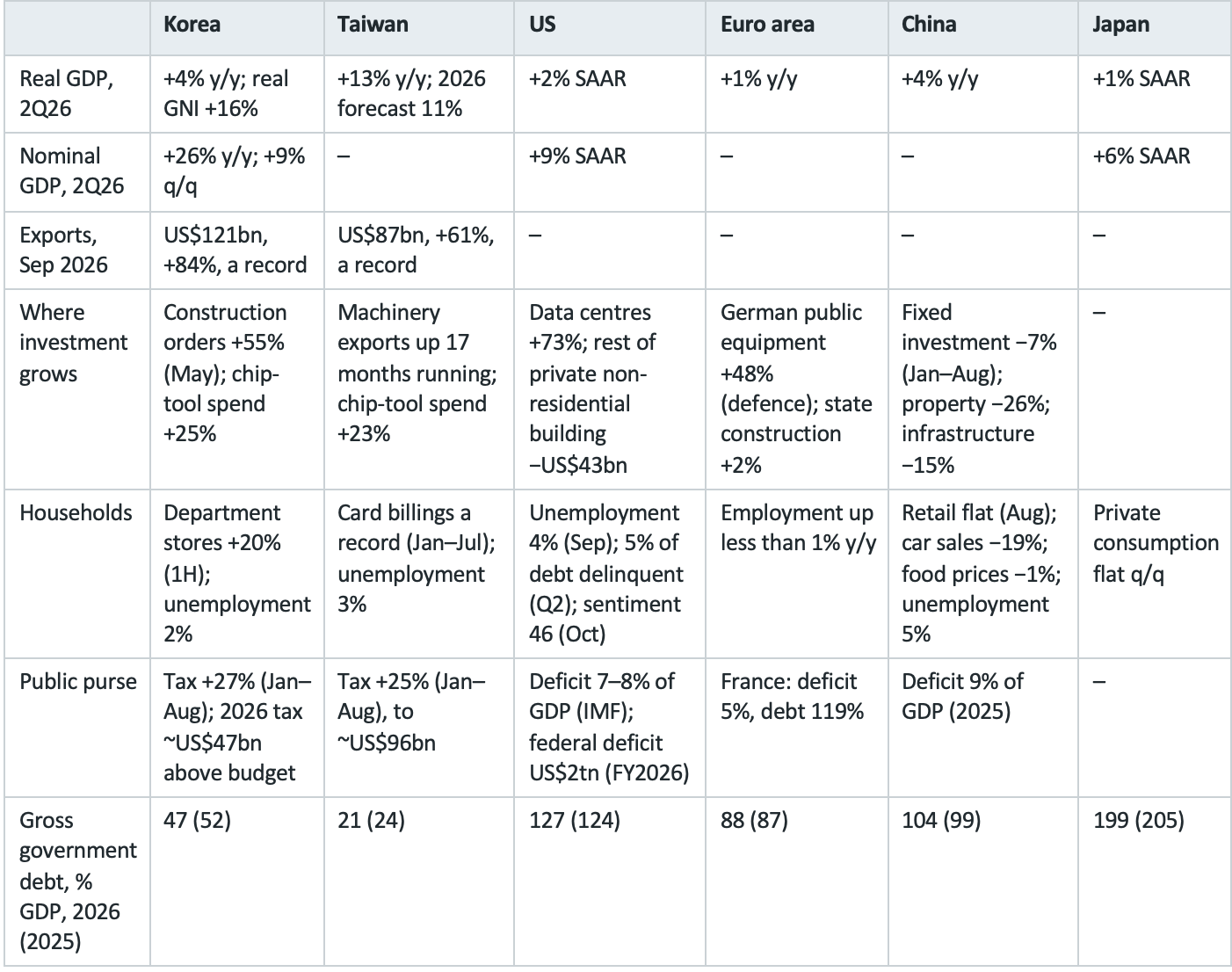
Start with the big capitals, where the trouble is fiscal. Washington is running a deficit of 7–8% of GDP, on the IMF's numbers. Paris is hunting for about US$60bn of savings while its debt heads for 120% of output. Beijing, ever the innovator, now sends its citizens friendly reminders through a tax app that it would like 20% of whatever they earn offshore. When a government starts rummaging through your foreign bank account, something at home is going wrong.
Seoul and Taipei have the opposite problem: what to do with all the money. Korea's tax take this year is running about US$47bn above budget, and next year's corporate-tax line is more than twice the old record. The government has had to set up a fund just to park the surplus. Taiwan's tax receipts rose 25% in the first eight months, to about US$96bn, and nearly half of the increase came from the levy on share trading. Taipei has proposed sending every citizen about US$310 in cash, with effectively no net new borrowing. In most capitals, "cash handout" and "no borrowing" do not appear in the same sentence.
The market prices both as if they shared everyone else's troubles.They don't. The lazy reading files the whole thing under "AI", as if Korea and Taiwan were a queue of data centres waiting for the next hyperscaler cheque. The chip boom is broader than that, and we will come back to how much broader.
For now, note that it has given both a record run of exports and,behind them, two things no other large economy has this year: a household paycycle that is only just starting, and governments with cash to spare. We thinkthis is the opening stretch of a multi-year wealth cycle, of the kind Chinaenjoyed after the global financial crisis, with one important difference. Chinaborrowed its way into its boom. Korea and Taiwan are being paid into theirs.
In our article, The Chip Economies,we argued that the windfall's second-round effects "are not yet priced in". Five months on, those effects are turning up in pay slips, property registers and tax ledgers. Share prices have yet to get the memo – as do investors.
Cloudy With a Chance of Debt
America grew at an annualised 2% in the second quarter, and close to half of that, on ING's reckoning, came from one line: computers, software and the buildings that house them. Private data-centre construction ran at an annualised US$85bn in August, up 73% in a year. Strip it out and the rest of private non-residential building shrank by about US$43bn, and factory construction fell by a fifth (20%). America has one engine running, and it plugs into the wall.
Look at things another way, and it looks not as exciting. Employers added 29k jobs in September, and an average of 66k a month over the past six months, the kind of hiring that used to come with an apology. Unemployment is 4%, up from a low of 3% in 2023, and pay growth has slowed to 3%, the slowest since May 2021.
Americans are still shopping, which is to their credit. Real spending is 3% higher than a year ago, but more of it is coming out of the cushion: the saving rate fell to 4% in August, its lowest since November 2022.The rest goes on the tab. Households owe US$19tn, 5% of it is behind on payments, and the New York Fed calls new card and car-loan arrears"elevated".
Washington's own books are in the same mood, with more zeros. The fiscal year that ended in September ran a federal deficit of US$2tn, and the interest bill alone rose by about US$115bn. On one budget watchdog's reckoning, no deficit has been bigger outside a war or a crisis. The ten-year Treasury yielded 5% on 13 October. Lenders have noticed, and are charging accordingly.
Korea & Taiwan: Bring Sunglasses
Now look east, where a good part of the market decides whether Korea has a fever by taking America's temperature. Yet momentum money trades Seoul and Taipei as a US rate bet in an inconvenient time zone. A hot CPI print in Washington or a jump in the ten-year Treasury yield, and Seoul and Taipei get sold within the hour, by models that have never read a shipyard's bonus notice. In July a 30 basis point rise in the US 10Y Treasury was blamed for knocking 22% off the KOSPI in a month. On 15 July a softer American inflation print for June added 6% to the KOSPI in a single day.
Yet, the domestic engines in these two economies have started firing, with little being noticed. Taiwan's households spent 6% more in real terms in the second quarter, and total wages rose 8% in July. Korea's unemployment rate is 2%. The pay calendar, from Lunar New Year bonuses to employee share plans, is written in Seoul and Taipei and runs to 2029. No CPI print in Washington moves a February bonus in Icheon or Taipei. And if a storm does blow in from abroad, both governments have the cash to be a safe port init, as we will see.
Korea. Nominal GDP, the economy measured at today's prices, rose 26% in the year to the second quarter. In the second quarter alone it rose 9%, not annualised. America's nominal economy is growing at an annualised 9%, so Korea did in three months what America manages in a year. The cleanest measure is real national income (GNI), which counts what a country's output can actually buy. It rose 16% while real output rose 4%. Korea is not making that much more stuff. It is being paid a great deal more for it.
September exports hit a record US$121bn, up 84%. The current-account surplus for January to August was US$279bn, four times last year's, and the won has risen 16% against the dollar since the end of June.
Taiwan. Real GDP rose 15% in the first quarter and 13% in the second, the strongest first half in fifty years. The statistics office expects 11% for 2026, a 39-year high. September exports hit a record US$87bn, up 61%. Unemployment is at its lowest for an August in 26 years.
Both. On the IMF's latest numbers, the two governments' debt ratios fall this year, Taiwan's to 21% of GDP and Korea's to 47%, while America's, China's and France's rise.
The weather map: six economies in 2026
Confessions of a Non-Economist
I am not an economist. I have spent my career in Asian equities sitting next to some very good ones, and I have great respect for the craft. An economist's job is to tell you, carefully and with revisions, what has happened, and the profession is right to wait for the data. Rear-view mirrors are essential equipment. Nobody should drive without one.
Managing a fund is a different trade. A fund manager is paid to squint through the windscreen, guess where the road bends and, now and then, notice when a price has wandered a long way from what it is worth. From my seat, Korea and Taiwan are being priced for somebody else's storm.
MSCI Korea trades on 5 times forward earnings, 3 standard deviations below its own history. Analysts have raised its 2026 profit forecasts by about 240% this year, and pencil in another 28% of growth for 2027. India, a fine market with a fine story, trades on about 21 times. Korea costs about a quarter as much, and as the table shows, not for want of returns.
Since June the index has gone one way and the forecasts the other. In September foreigners sold US$17bn of Korean shares and Korean companies bought back US$23bn . Every sale has a buyer, so we read nothing into the flow, except perhaps which side had the closer view of the accounts.
Taiwan is not cheap on a headline multiple. What it has done is get cheaper while getting richer. Its forward P/E fell from 22 times in May to 19 times in September, while analysts raised 2026 and 2027 earnings by another 4%and 5% in September alone. The island is priced as a chip trade. Nothing in that multiple pays for 11% real growth, a falling debt ratio, a cash handout or a nation of new shareholders.
The discount for sunshine:what the market charges for a better forecast

So much for the price. Now for the local forecast.
Silicon Gets a Life
Back to that lazy reading, in which Korea and Taiwan are two memory chips and a server rack wearing national flags. September's trade data disagree. Strip out semiconductors and Korea's exports still rose 23%. The shipyards are booked into 2029. Transformers and switchgear are sailing to an American grid that cannot get enough of them, and Korea's defence makers carry three to five years of orders from Europe and the Gulf. Cosmetics rose 31% and batteries 14%.
Taiwan tells the same story with different products. Its exports outside electronics and ICT rose 25% in September, the fastest in about five years, and machinery exports have grown for 17 months in a row. These customers, from shipowners to American utilities, have budgets of their own and very few suppliers who deliver on time.
Strip out the chips and the order book still grows

Additionally, while the easy trade is to think that all silicon is for data centres, the reality is that it has moved into the rest of life. Today's car carries roughly US$1,000 of semiconductors, and S&P Mobility expects more than US$1,400 by 2030. The world installed 542,000 industrial robots in 2024, twice as many as a decade earlier, and Korea runs 1,220 of them for every 10,000 factory workers, the highest density on earth. Robots need eyes too: Taiwanese brokers expect the island's sensing-chip designers to grow sales by about 22% next year.
None of this is a fashion purchase. Korea became a super-aged society in December 2024, with more than a fifth of its people over 65, and Taiwan followed in 2025. Korea expects its working-age population to shrink from 37m in 2023 to 27m by 2044: more than 9 million pairs of hands gone. A society running out of hands buys machines that have them. So does the rest of the ageing rich world, and most of those machines need a chip made in Taiwan and memory made in Korea.
Everyone Gets an Envelope
The second lazy story says AI made a few thousand memory engineers rich and left everyone else to admire their cars. Start instead with someone who has never touched a wafer.
This February a Korean shipyard paid its staff a bonus of 400% of base monthly pay, and exactly the same to its sub contractors' workers. Another yard paid 559–638%. Power-equipment makers, whose transformers America's grid is queueing for, paid their rank and file around 1,180–1,195% of base monthly pay, a year's base salary in a single envelope, and some staff collected 2,600%.
Taiwan's pay slips tell the same story with less shouting. Average pay across all listed companies rose 7% in 2025, to about US$45,500, and 22 industries outside chips raised pay too. The club of listed companies paying an average of more than US$62,500 now has 118 members and about 207,000 people on the payroll. Year-end bonuses hit a 17-year high on one survey and a 15-year high on another.
The factory floor is busy as well as better paid. Electronics workers put in 29 hours of overtime a month in July, the most for any July in 47 years, and IT and electronics added 35,000 jobs in seven months. At a job fair beside TSMC's new packaging plant in Chiayi, a farming county, 22 chip suppliers turned up offering US$1,250–1,875 a month. Rice paddies have rarely had such generous neighbours.
Even inside the chipmakers, the money spreads wider than the headlines suggest. Under Samsung's chip bonus, confirmed on 7 October, 40% of the pool is shared across the whole division, and common functions such as research get 70% of the memory unit's rate. Press estimates put a memory engineer on about US$60k a year in line for roughly US$560k before tax. The state, never one to miss a party, withholds about half at vesting.
Then come the construction crews, who are paid long before any engineer opens a letter. More than 20k people a day work at Samsung's Pyeongtaek site, and SK Hynix's Yongin site expects up to 26k a day when the build reaches full strength early next year: on our estimate, about US$3bn of site wages in 2027.
And then there are the owners. 14 million Korean individuals held listed shares at the end of 2025, more than one Korean in four, and TSMC had 2,670,000 shareholders by May.
Who else gets an envelope, and when it lands

The One-Off That Isn't a One-Off
Bonuses like these were supposed to be a lucky year's thank-you note. They are turning into furniture. Samsung's formula sits inside a ten-year agreement, and SK Hynix has committed to its 10% for ten years. Both are uncapped, so each year's payday tracks that year's profit. One shipyard union now wants 30% of operating profit, which is the chipmakers' formula with a bigger number, and it wants the same deal for subcontractors.
Taiwan has gone a step further and written it into the rulebook. From 2026 earnings, the regulator requires all 1,874 listed and OTC companies to set aside a fixed share of every year's profit for staff earning about US$1,970 a month or less. Profit sharing for the factory floor is now annual by rule, and it reaches people who will never see the inside of a cleanroom.
Once a windfall has a formula, a regulator and brokers publishing per-head estimates of next year's payout in January, nobody calls it a wind fall any more. They call it payday, and put it in the diary.
The diary is staggered, which is half the reason the market misreads it. The money arrives in pieces: quarterly profit shares, Lunar New Year bonuses, February cash, spring shares and summer top-ups, then again every spring until 2029. No single month carries the whole payment, so no single month's retail-sales figure can catch it.
The Wedding and the Car Park
Which brings us to the soft retail numbers. Korea's monthly retail sales have been lumpy this year, and every lumpy month brings a fresh note asking where the consumer went. The answer comes in four parts.
The income arrived. It sits in that twelve-point gap between real national income and real output: money in Korean pockets that a retail print never sees.
Households saved it first. In 2025 Korean households put aside a record US$201bn more than they borrowed. A family that comes into money usually pays down the credit card and builds a cushion before it goes shopping, which is the American habit run in reverse. Korea's families have been stretching before the run.
Then they bought homes. The Bank ofKorea followed SK hynix's February bonus into the districts around its fabs. Shopping did rise: residents there outspent the rest of Korea on their cards by up to 4% a month, about US$820m of extra spending between February 2025 and June 2026. But the share of each bonus that went to the shops fell, from 27% in2025 to 21% in 2026, because a bigger share went into property. The bonus did not skip the mall. It stopped at the estate agent first.
The biggest cheques haven't been written yet. Korea's two chipmakers will pay about US$43bn of profit share on2026 earnings between February and April 2027, on our estimate. TSMC's largertop-up lands next July, and Samsung's shares keep vesting until 2029.
Judging this cycle on October's retail sales is like reviewing awedding from the car park before the doors open.
Postcards From a Boom
If you prefer your proof without a spreadsheet, follow households in the order they spend: the house, the broker, the car, the passport, then the shop. It is the order the Bank of Korea observed.
The house. Seoul apartment prices have risen for 87 weeks in a row, the longest run on record. Prices in Dongtan, beside Samsung's Hwaseong fabs, rose 16% in the year to early August, the fastest in Korea, and topped the national table for four straight weeks into October. People taking out mortgages to buy in Gyeonggi, the chip-belt province, now earn a record median of about US$48,700 a year, up 10%.
In Taiwan, new homes in Hsinchu cost about US$6k per square metre,21% more than a year earlier, and the city has gone from the back of the seven big metros to the front in a year. New-home prices in Kaohsiung, where TSMC is building its newest fabs, are up 16%. Hsinchu engineers have taken to phoning developers for a group-buy price before the pre-sale even opens, the way the rest of us club together for a takeaway.
The broker. Taiwan opened about 990k securities accounts in the first nine months, its biggest year on record, and63% of September's new accounts belonged to people under thirty. Life insurers wrote about US$33bn of new premium by August, about 60% more than a year earlier, with investment-linked policies up 135%.
The car. Korea registered around 280k imported cars in the first nine months, up 24%. In September, private buyers in Gyeonggi bought about 75% more of them than those in Seoul. In Icheon, SKhynix's home town, imported-car registrations rose 81% in the month the bonus landed.
The passport. Koreans and Taiwanese made up 47% of all visitors to Japan between January and August. Both set June records, and this year their extra 2 million visitors have filled more than half the gap left by China. In August Koreans set a record for the month, at 850k. Taiwanese visitors passed 700k in a month for the first time in July, after a record 19m outbound trips in 2025.
One epicentre now spends in the other: 186k Taiwanese came to Koreafor medical treatment in 2025, up 120%, nearly nine in ten for skin or cosmeticwork.
The shop. Korean department-store salesrose 20% in the first half, and watches and jewellery rose by half at one chain. Alternative transaction data showed Korean luxury and premium department-store sales still accelerating into July, "supported by the wealth effect". A senior merchandiser at a global luxury house told an industry call that in Korea "many people who did not previously buy luxury have entered the market".
In Taiwan, credit-card billings set a record of about US$104bn inthe first seven months, and when one large department-store chain opened itsanniversary sale on 1 October, early reads had premium beds up about 30%.
First-time luxury buyers in Seoul, Taiwanese shoppers upgrading themattress: this cycle is getting comfortable.
Rolling in It
Korea's finance ministry has spent the autumn counting. On 30 September it put 2026 national tax at about US$357bn, which is where that US$47bn overshoot comes from. For 2027 it expects about US$436bn, up 41%. The corporate-tax line we started with comes to about US$162bn next year, against a 2022 record of less than half that.
Seoul has chosen to bank most of it. The new Future Response Fundholds tax above its ten-year trend: about US$121bn, of which US$78bn sits in reserve, US$34bn is spent and US$9bn goes to repay debt.
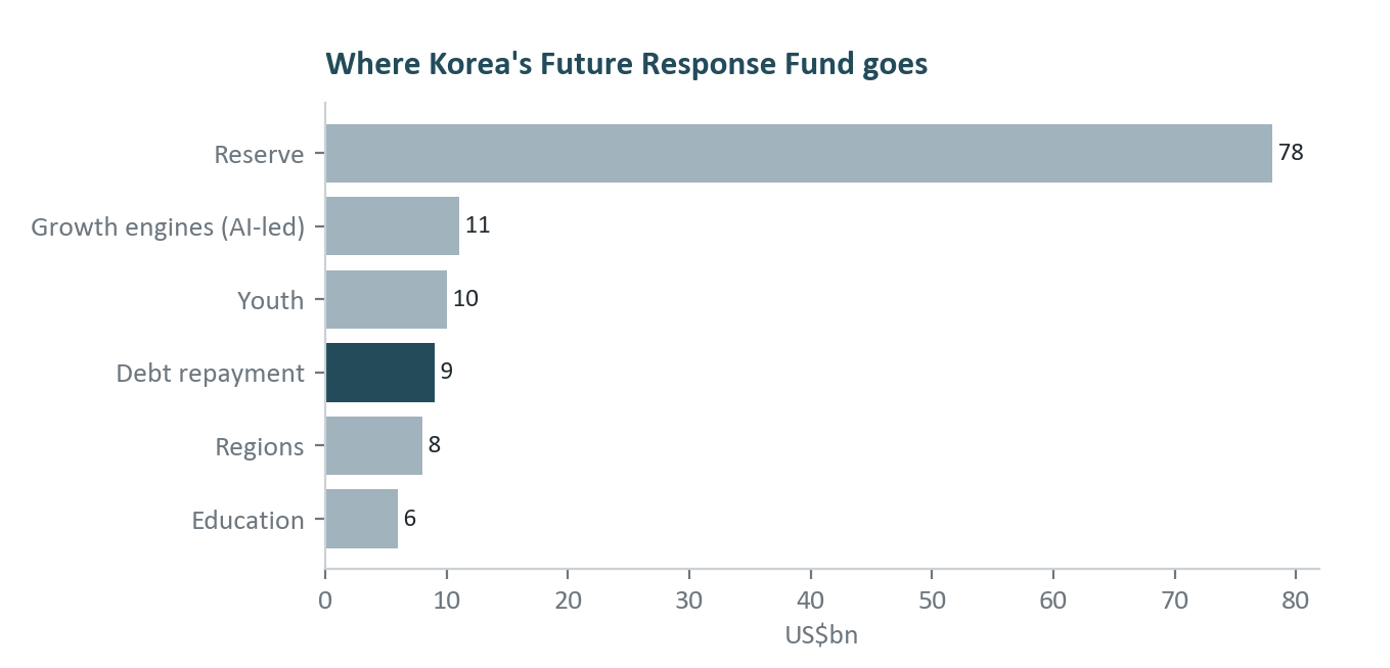
Total 2027 spending rises 13%, the fastest since 2005, and R&D rises 11%. The state development bank runs a US$13bn chip-capex programme to2027. Down at Icheon's town hall, the city expects about US$456m of local corporate tax this year, close to five times its take two years ago. Its council meetings are presumably now about fountains rather than potholes.
Taiwan is running the same play with a different accent. Thats hare-trading levy, the source of about 46% of this year's rise in tax receipts, stays at home whoever does the trading, so a nation of new shareholders is also a nation of new taxpayers. Central-government revenue for 2027 has been raised to about US$123bn.
On 17 August President Lai put a price on that cash handout, about US$7bn, in a budget he called balanced, "with effectively zero borrowing", and one that does not raise net debt. Finance ministers elsewhere may wish to sit down. Taiwan's banks, meanwhile, lent about US$22bn to the government's strategic industries in four months, six times the full-year goal.
Put the pieces together and these two treasuries are the safe port in the storm we promised: an internal safety net, already paid for. If trouble does blow in from abroad, Seoul meets it with that US$78bn reserve, collected from this year's profits, in a fund that is also paying down debt. Taipei is paying its handout out of income. Both debt ratios are falling, as the weather map showed, while America's climbs towards 127%. Behind them sit foreign-exchange reserves of US$601bn in Taiwan at the end of September and about US$422bn in Korea at the end of July.
Most governments meet a rainy day by reaching for the credit card.These two can reach for the savings jar.
Two Scripts for a Fat Wallet
History gives a government with spare cash two scripts.
The first is to bank it. Norway's oil fund received its first transfer in 1996, invests only abroad, and lets the budget draw about 3% a year. By design, it leaves domestic assets alone. Korea's new fund follows this script for the part it keeps in reserve.
The second script is to recycle the money at home, through handouts, infrastructure and paying down debt. China after the financial crisis showed what happens when a state with firepower meets households about to discover they are richer than they thought. Beijing launched a RMB4tn (about US$586bn) package in November 2008. The Shanghai Composite rose 80% in 2009, and Shanghai new-home prices, on one measure, rose 68% that year.
Then the newly rich went out. Macau's gaming takings tripled between2009 and 2013, outbound trips doubled from 48m to about 98m, and by 2012 Chinese shoppers bought a quarter of the world's luxury goods. The domestic businesses that served them, from insurers and brokers to airlines and handbag makers, outran the factories that started it all.
With the money they spend, Korea and Taiwan sit firmly in the secondcamp, as they did in the late 1980s, when their first big trade surplusesarrived and their savers discovered the stock market. The difference this timeis the funding. China's cycle ran on almost RMB10tn (some US$1,400bn) of newbank loans in 2009 alone. Korea's and Taiwan's run on tax receipts, householdsavings and treasuries that are paying debt down, not up.
Don't Throw the Baby Out With the Bathwater
The market has been taking America's temperature and prescribing for Seoul and Taipei. Put down the broad brush and read their own numbers: record exports well beyond chips, pay rising from the shipyard to the factory floor, and treasuries that pay down debt while posting cheques to citizens.
That is roughly how China looked in 2009, at the start of a wealth cycle that ran for years, and whose biggest winners served the newly rich rather than making the exports. Here the pay calendar is written out to 2029 and, in Taiwan, into the rulebook. Year one already has dates on it. And unlike China's, this one is paid, not lent.
Haze seasons end the way they begin, without asking anyone's permission. The wind turns, the skyline comes back, and everyone wonders how they spent weeks squinting at buildings that were there all along.
Those who make money spend money. Our Epicentres work is about where, and in what order, and this is the kind of flow the GenInnov Epicentres Fund, concentrated by geography and diversified by sector, is built to follow.The market is throwing out the baby with everyone else's bathwater. We would rather keep the baby.