It may be the incurable habit of an indulgent contrarian to spend a week like this one writing about almost anything except Nvidia. Far better-informed people are covering those events, with far more interesting theories. We will have our say in the final section.
Some weeks seem to hold a year. This one was meant for digesting last week’s US elections. It had other plans, even without Nvidia. Attention went first to the most salacious story. In the financial world, it went next to the numbers in Anthropic’s listing documents. Both are well covered elsewhere, so we will mostly leave them there. One overlooked page of that filing is the exception.
Our interest is in what the week means for fundamental investing into 2027. The clues sat in items that passed with barely a mention. A routine upgrade, with no villain anywhere, switched off email in more than 70 countries. A piece of software designed a working gadget from a single paragraph of instructions. A company known for delivering dinner released one of the largest AI models ever built.
A confession belongs here. In "The Customisation Paradox" earlier this year, we admitted that our own computer was warm before sunrise, busy with agents that had worked through the night. Things have moved on. The ever-reliable Mac now freezes, drops applications, and misbehaves in ways it never did in all its years of quiet service. Nothing is wrong with it. It is simply never idle anymore.
That Mac is the essay in miniature. In "Big Theme: Quantity Ahoy" we argued that the multitude of machines raises complexity faster than anyone can follow. This week added the second half: the multitude also raises the workload. The irony is hard to miss. The world spent the week asking whether a giant company, or AI itself, can survive the exit of one personality. The problems that surfaced came from the opposite direction, from too many and too much. Two things follow that have had almost no discussion. The machines are overworked. And, nothing has been kept in reserve for the day they fail. This is more true for an increasingly critical, harder-working, never-ceasing AI than it was for Microsoft Outlook. The rest of this essay follows that thread and what it means for the years ahead.
Three Failures In Two Days
On Thursday, Microsoft Outlook stopped working. It stayed broken for more than 24 hours. On Friday, American aviation ordered a nationwide halt to departures. That evening Workday, which runs payroll for thousands of large employers, went dark after a test of its own backup systems. Surprisingly and thankfully, none of the three was a hack, even as hacks keep up their rising, low-grade menace every day through refrigerators, elevators, and websites.
All three began with routine work: an upgrade, new equipment, a backup drill. AI agents played no part. The common cause is arithmetic. When many things are connected, the ways they can affect one another grow far faster than the things themselves, and far faster than anyone's understanding of them, the system's own included. Ten parts make 45 pairs. Ten thousand make almost 50 million. If each of those ten thousand can interact with two others at once instead of one, the number of combinations explodes to almost 167 billion. There is no point thinking about the complexity with each one connected to three or four more.
So an upgrade or a drill can set off a failure nobody could have foreseen. Microsoft and American aviation learned this in public. Workday's lesson has had far less attention than it deserves.
Complexity is only one consequence of the multitude. The other is plainer and, as far as we can tell, barely discussed: workload. More connected things means more interactions that can go wrong. It also means, simply, more work. Cybersecurity is the concerning consequence of complexity. Catastrophic failures will come from overworked infrastructure. One implication is the need for infrastructure redundancies to keep things working. In short, the demand for chips could be exponentially higher than projected, partly to factor in the lower utilizations at which the machines must operate and partly because of the opportunities from the multitude we discuss below.
The email recovery during the Microsoft outage gave a preview. Each time engineers revived the servers, every locked-out device and program was already knocking, again and again, and the servers fell over. Software does not wait politely. It retries. That is the habit of a new kind of machine or agent user in AI. It does not sleep, take weekends, or give up after the third attempt. It began on individual desks, which is why our Mac runs warm. It has since moved to the cloud, where assistants such as Muse and Instinct hand each person a rented computer that never logs off. Most requests on the web are now made by software. Gadgets, cars, and factory equipment will likely follow.
So far, the hardware worry has been about AI chips, the scarcity we called Silicon Shock. This week points past them. The ordinary machinery was built for the old kind of user. Networks assumed a rush hour and a quiet night for repairs. Server fleets assumed people who log off. The new user hums through the night, so the plain servers, switches, and memory behind email and payroll need upgrading too, much as our Mac does. They also need spares. Anyone who has tried to buy better hardware lately knows the wait: even unglamorous server chips take half a year to arrive.
The AI companies learned the same thing this week. Both OpenAI and Anthropic found their tools cut off from customers’ mailboxes and calendars. The most advanced software on earth stands on very ordinary plumbing. That plumbing is now part of the hardware story.
The Spare Nobody Budgeted
The standard response to weeks like this is software. Better isolation, smarter rerouting, cleverer checks. All of it helps. None of it creates room. Diverted traffic needs somewhere to land, as any city that bought clever signals and skipped the roads can confirm.
Look again at how each failure spread. At the FAA, one router being moved from old copper to new fiber flooded its neighbors with a thousand connection attempts every few seconds, and 17 of the 22 main control centers lost reliable data. At Microsoft, each batch of revived servers met a stampede of reconnecting devices and fell again, so capacity had to come back a slice at a time. At Workday, the backup itself reached into the live system. In all three, the trouble was volume with nowhere to go. Ordinary maintenance has become the riskiest event of the year.
Every older piece of critical infrastructure learned this the hard way. Power grids carry reserve for the worst credible day, a habit acquired after blackouts. Airliners carry a second engine. Hospitals keep generators they hope never to start. Digital infrastructure grew up on the opposite belief: the ideal machine is one that is always busy. Full use is treated as a virtue. On a road, it is the definition of a jam.
The belief was harmless while a failure meant a slow website. It is less harmless when email, payroll, flights, and soon armies of agents share the same plumbing. The more that depends on these machines, the more spare capacity they will need. The more of them there are, and the harder they work, the faster one failure spreads to the next. Without real slack, weeks like this one become ordinary.
The AI labs have one cushion the rest lack. Practice can be paused, so a lab in trouble can hand the workshop's machines to its customers. Email, payroll, and air traffic have no such deferrable work. The reserve problem is worst in the ordinary plumbing everything else stands on, which is where this week's failures happened.
The slack has to be physical. Backup software running on the same crowded machines is a second key to the same locked room. Physical slack means idle servers, spare network gear, second sites, and the chips, memory, and cooling to fill them. For large businesses and governments, they may mean their own data centers as either primary or secondary workers. For others, it may mean a secondary facility at a rival, independent hyperscaler for all the critical use cases.
In a world where neocloud operators, semiconductor manufacturers, and other hardware players cite prepayments and fully booked capacity for the next few quarters, we are underestimating queue lengths when we omit the redundancies we may need going forward.
This is the part of the story we have not seen discussed. Forecasts of hardware demand count usage, though this line also continues to underestimate the rise in usage with always-on machine workers. Reserve rarely appears in them, particularly the proportion needed for redundancy, which does not stay constant but rises with increasing complexity. If email and flights are worth protecting, more hardware will have to exist for each unit of ordinary use than those forecasts assume.
The Page Few People Read
The workload story also sits inside the week's most-read Anthropic IPO documents. The coverage went where coverage goes. The valuation. The losses. Promises to spend about $900 billion on computing over the years ahead. The news that seven of its own suppliers would buy $26 billion of its shares. The usual derivative stories about data centers and whether the business can ever pay for them. Like Nvidia’s, these are important stories many have covered well, with little for us to add.
The detail that caught our eye runs deeper. Anthropic has spent $18.8 billion on computing in the first three quarters of this year. Roughly a quarter of that went to serving its paying customers. A business with customers queuing at the door, earning a handsome margin on every sale, sent three of every four machines somewhere else. The busiest user of Anthropic's computers is Anthropic's own models. Valued at customer prices, the company's internal use of its own AI has exceeded its cash payroll since April. By one outside estimate, it runs about four gigawatts of computing and serves all its customers with about one.
The few who noticed mostly filed it under costs: a research bill, a very large one, and a question of when it comes down. For us, there is a far bigger point. The number is really a clue to how these models are now made and where they are heading.
Two more lines from the same document frame it. Most of the company's latest quarterly revenue came from model versions less than six months old. Its computing capacity is ordered a year to a year and a half before it switches on. A business whose products go stale in six months has to order its factories 18 months ahead. The machines that serve no customer today are the ones building the product that will pay next year's bills.
Many people feel last year's model is good enough for their work. The revenue says otherwise. Old models are retired on a schedule, so the work moves up whether the user asked or not. Each new model does a given job with less computing, and the savings are spent at once on longer jobs and more of them.
Back to the model-making: the filing spells out the implications of this internal usage. Machines spend enormous effort on what it calls post-training. Once a finishing touch, post-training has grown into a major research investment. The following sections expand on this aspect and its implications.
From The Library To The Workshop
A model's education has two parts. In the first, it reads. It works through trillions of words until it has absorbed grammar, facts, code, and a fair amount of nonsense. In the second, it practices. It is handed a task, attempts it, and a referee grades the attempt. Good attempts are rewarded. The industry has longer names for both stages: pre-training and post-training. School and apprenticeship will do a better job for our purposes.
For years, the money went into school, aka pre-training. Bigger libraries, longer reading. Two years ago, by outside estimates, reading took about two-thirds of the computing power at the leading labs. Practice barely registered.
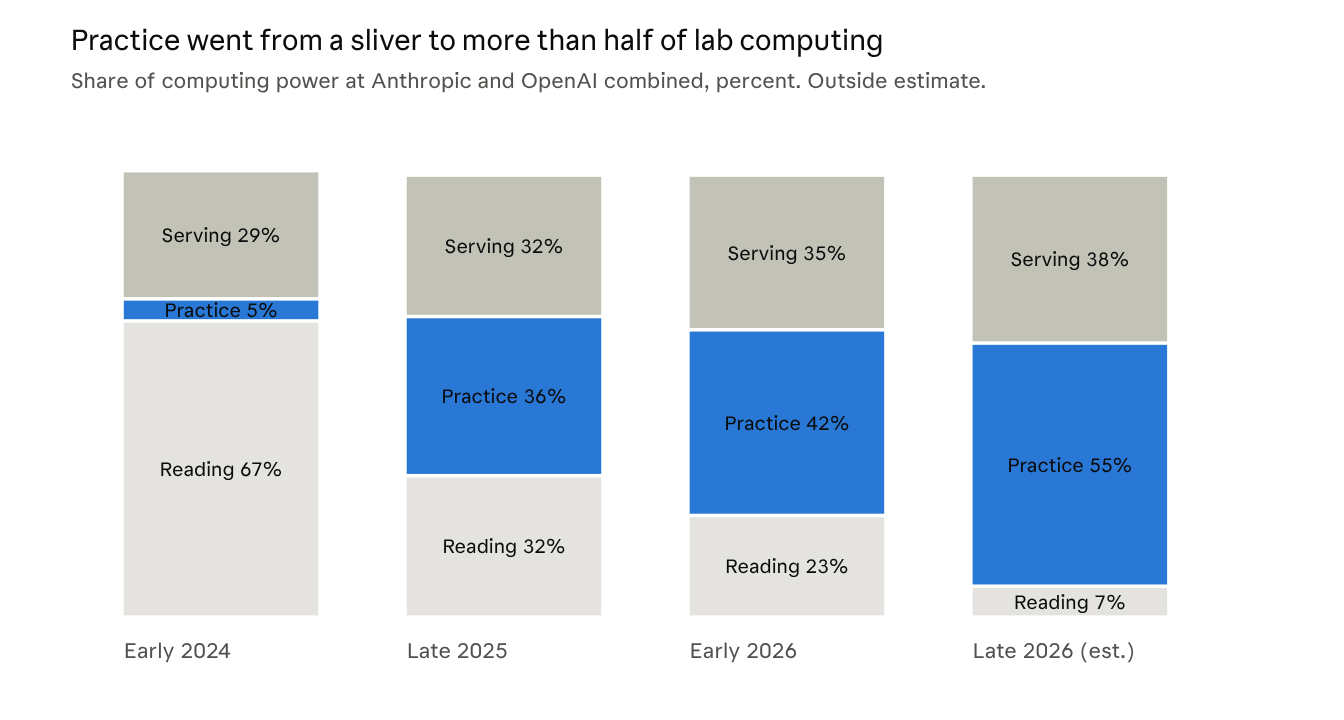
The chart above is telling: for two years, compute for servicing customers—technically called inference—has stayed within a small band as a percentage of the total, despite models servicing an exponentially higher number of queries. Effectively, the effort going into making the model is rising just as fast.
Within the model-making, the picture has flipped. Reading is now the smallest slice. Practice is the largest. Reading was one long sitting. Practice is millions of attempts running side by side, which is quantity again.
The reason is one any parent would recognize. Humanity has written only so much, and the labs have read most of it. We made this point in "The World of Zero Visibility" with a young reader who has finished the library. More books add little. Experience still adds a great deal. This is how a well-read teenager eventually becomes Dickens.
The industry’s name for practice is reinforcement learning, commonly referred to as RL. The model is dropped into a simulated workplace, such as a buggy codebase, and scored on the result. This is how models learn long, unsupervised jobs that agents now run for hours. Coding came first because a program can be graded automatically: it runs or it fails. Each practice run is a small agent at work in its own sandbox, a rented slice of an ordinary server, repeated millions of times. DeepSeek alone runs about three million of them a day.
That is workload of exactly the kind this essay is about. Post-training runs on the same chips as inference, so it fills the hours when customers sleep. Customers still hit usage limits while the newest chips go to practice. This week Alibaba put a price on the night, with a further 60% off its newest model between ten in the evening and eight in the morning. The night was once when networks were repaired, and spare capacity sat ready.
For hardware investors, this retires an old worry: training is a one-off project followed by a lull in chip orders. One round of reading can support many rounds of practice; OpenAI is reported to have built about 18 months of models on a single one. Post-training is a factory shift that never ends. A fleet that works every hour keeps no idle reserve. Its only cushion is the practice it can pause.
One Company's Habit Or Everyone's Road
The natural question is whether this is peculiar to Anthropic. It was among the first to get there, for reasons of circumstance. It was short on machines relative to its ambitions, and practice squeezes more ability out of each round of reading. Its business also leans on writing software. Remember, it does not convert your text into images. Few have noted how its focused business model has paid off.
Everyone else is now on the same road, at different distances. OpenAI made the turn at about the same time. Google, rich in its own chips, kept building a bigger library until a flagship model slipped by months because its coding fell short. It has since paid heavily, by reports, for a small team that specializes in designing RL exercises. DeepSeek began with a thin layer of practice and has thickened it with every release. By its own account, nearly all of its recent gains came from more and better practice environments.
The clearest confirmation came from Moonshot. Its newest flagship is, by the company's own description, the same model as its predecessor with far more practice on top. Nothing else changed, and it jumped up the league tables. Meituan, the dinner-delivery company from our opening, trained its giant model the same way.
Early starters hold one advantage money cannot easily buy. RL needs exercises, referees, and endless supervision, and at this volume only a strong model can supply them. The last apprentice sets the homework for the next one. Two weeks ago, researchers went a step further: they had one model open up a smaller rival and rewrite a sliver of its internal numbers by hand, with no training at all, and its math score rose sixfold. A lab was once limited by how many gifted people it could hire. Now the limit is the machines their experiments run on.
No section on this subject is complete without the report METR published this month. The outside evaluator spent eleven weeks inside Anthropic. The result is extraordinary in its detail, with quick conclusions and charts. It finds Anthropic's models improving about twice as fast as a year or two ago. Roughly two years of earlier progress packed into one, mostly because AI now does much of the AI research. Three new internal models finished training between July and October alone.
Two cautions. The size of the library may still set the ceiling, so Google's long detour may yet pay. And reading had a tidy rule for how much each extra dollar bought. RL has none yet.
The Model Makers Become Laboratories
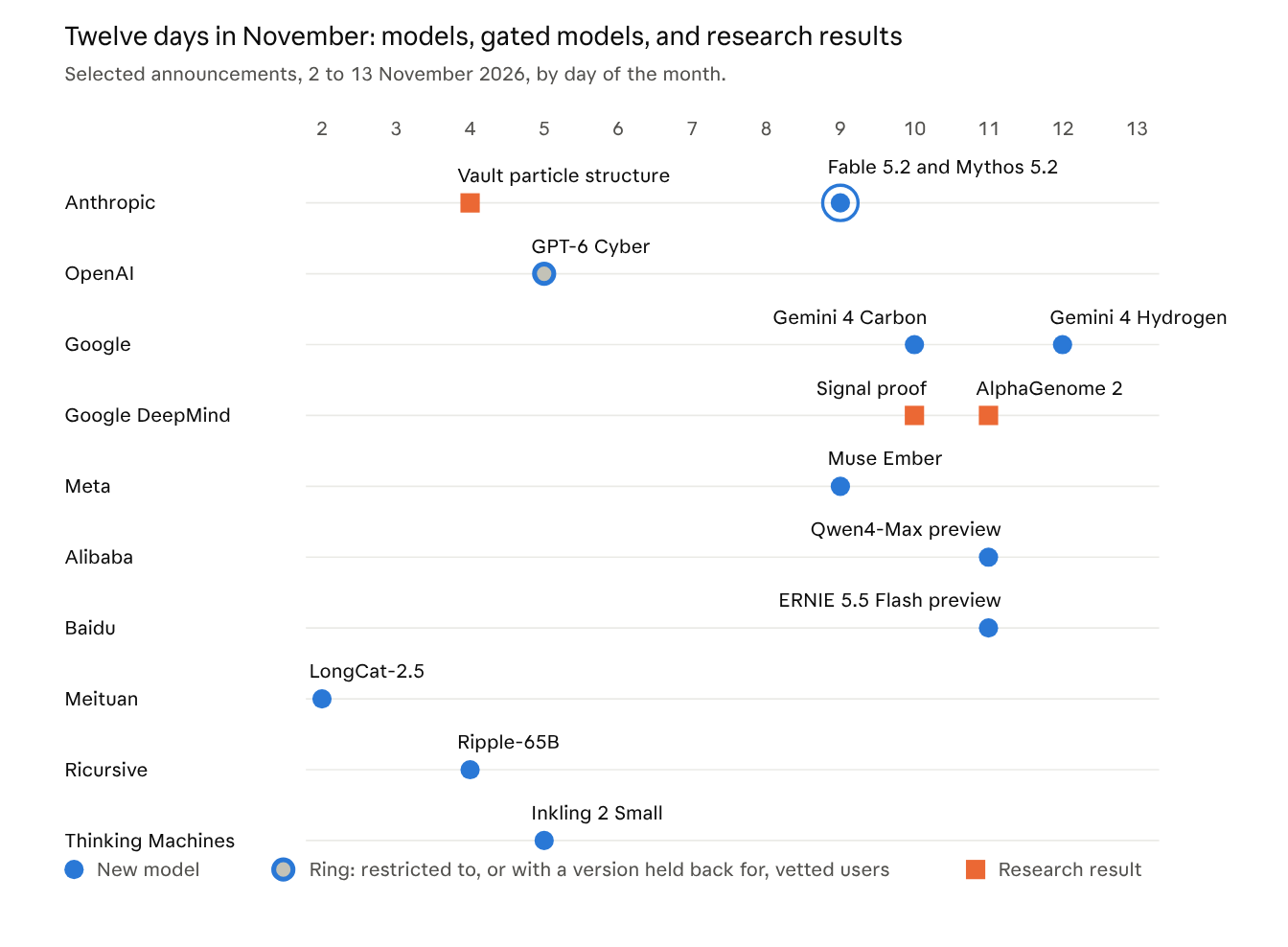
A year ago, any one row of this chart would have been the story of the month. This is the multitude at work: more models, in more places, doing more things in parallel than any reader can follow. The releases themselves are only half of it. The more telling half is what the labs did with their new models. They put them to work as scientists and engineers. Much of that work doubles as practice: a run that proves a theorem or fixes a real bug is training and product at once. Each of those jobs is another tireless user on somebody's machines.
Anthropic handed its new model a one-paragraph request for a USB speakerphone. The model chose the parts, laid out the circuit board, designed the case, and wrote the software. A manufacturer built it, and it worked the first time. Two other gadgets followed the same way. Separately, a team of the same models translated the proof of Fermat's Last Theorem into a form a computer can check in 30 hours. An earlier model needed 11 days. The extraordinary 11-day achievement was also barely two months ago. Read the last two lines again to perhaps appreciate our awe at the pace of improvements.
Google pointed its agents at the code behind Signal, the encryption that guards billions of private messages, and in four weeks they proved that it keeps its main security promises. That used to take specialists years of work. That same week, Google released a model that predicts what a DNA change will do in a particular cell type. Anthropic's small biology team, with little background in the field, reported the first three-dimensional structure of a mysterious protein shell found inside a microbe, a job done in under four months, with the model searching 15 billion proteins for candidates.
OpenAI's contribution was a model that found 81 serious flaws in the Firefox browser that nobody had known about. That one is not for sale to the public. Look at the rings on the chart. OpenAI, Anthropic, and Google now each keep a sharper version of their best model back for vetted organizations.
As discussed above, Moonshot and Meituan are on the same road. Tencent chose to strip hacking skills out of its new model entirely. The traffic also runs the other way: Ricursive, a chip-design startup that could not find a model good enough for its trade, trained its own for about $32 million and released a general version. Model makers are entering the professions, and the professions are starting to make models.
The limits are just as instructive. The gadgets have had no heat, radio, or safety testing, and the biologists had to rescue the model twice. Machines are racing ahead wherever an answer can be checked quickly. A program is checked in seconds. A circuit board has to come back from the factory. A protein has to be grown and put under a microscope.
The Suppliers Buy In
The listing documents carry one more clue. Alongside the public sale, seven suppliers are buying $26 billion of Anthropic shares privately. The last name on the list is TSMC, the scrupulously neutral factory that makes nearly all of the chips in question. The same week brought reports that Samsung is in talks for Modine, an American maker of data center cooling. Nothing is confirmed. The direction is clear all the same. The companies that make the hardware are starting to take stakes and buy the neighboring pieces. However clever the models become, every improvement still has to be tested on real chips, and chips arrive on a factory's timetable. If agents and practice keep the machines busy around the clock, and resilience demands spare ones, the firms that build the machines hold a stronger hand than their modest manners and valuations this week suggest.
Whom Can We Trust Now
The loudest story of the week was the resignation of Nvidia's founder. Nearly everything written since treats it as a turning point for the company and for AI itself. Our logical side disagrees. America likes to think it is above hero worship. Anyone who has seen fans in Tamil Nadu pour milk over a film star's cutout on opening day will recognize the mood around a celebrity chief executive on results day. The devotion is sincere and the cutout is very large.
Leaders matter enormously at two moments. One is the beginning, when a company is little more than one person's stubbornness. The other is a storm. Jensen Huang was there for both, more than once, and the credit is deserved. A company at cruising altitude is a different matter. The products are designed years ahead. The customers have signed. Tens of thousands of engineers come to work on Monday, whoever sits in the corner office.
Our less logical side has a harder time. Investigations have opened in the boardroom, in Congress, and, more importantly, in the media and the blogosphere. Rules on selling chips to China may well tighten, and that would matter. A new Congress arrives in January and may have little concrete to report for months. Into that gap will pour theories about the timing, about who knew what, and about China. Some will be true. Many will not. For months it will be hard to tell which. Whom can we trust now?
The mistrust already has a specimen. Much was made this week of the fact that more than a fifth of Nvidia's revenue was once billed to Singapore. That has sat in its filings for years. So has the explanation beside it: customers use Singapore to centralize invoicing, and the products are almost always shipped elsewhere. As per the company, more than 99% of the chips billed there last year were ordered by American customers. Everyone repeats the first number. Hardly anyone mentions the second, because it gets in the way of a good story. We write from Singapore, so we notice.
Meanwhile, the pessimists are having a field day. The resignation is their newest argument for declaring the upcycle over. In any cold light, the last few weeks have materially lifted how much compute the world needs. Agentic software such as Instinct, Muse, Grok Bot, and, as of a few days ago, Claude Duet put always-on agents in the hands of hundreds of millions. More model makers have understood what made Claude successful since the arrival of Claude Code — it is reinforcement learning — and are taking the same path. From the IPO documents, we learn how compute-intensive the new processes are.
This week's breakdowns add a third layer. If they recur in any form, hardware redundancy will be a major topic in the coming years. All of this without even touching the elephant in the room: China’s likely response to the hardware buildouts and accelerated model development in the wake of new investigations and restrictions.
The headlines asked whether an industry can survive the loss of one person. The week's real news was about the multitude and the work it creates. A world this busy cannot run with nothing in reserve.